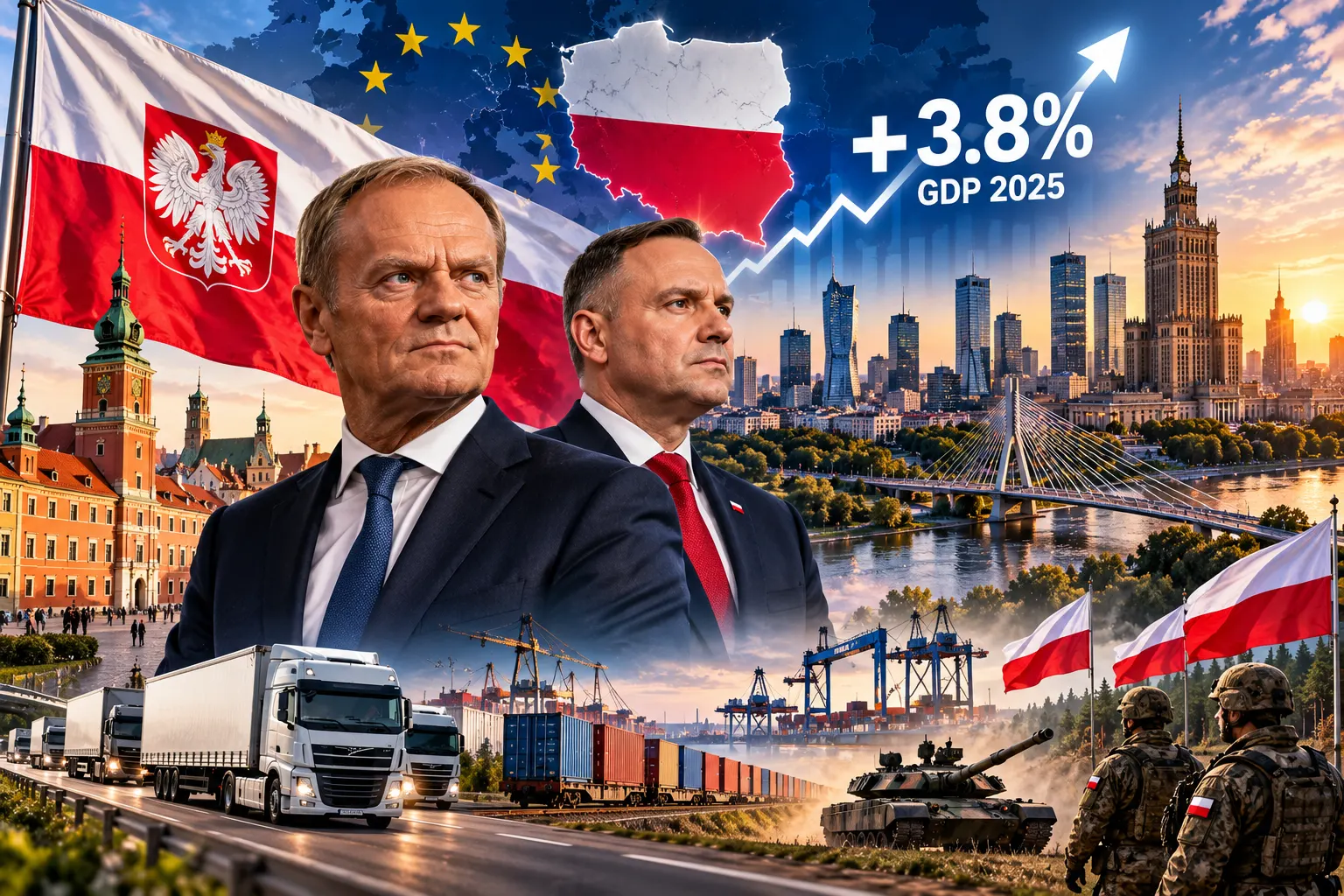
Poland’s economy expanded by 3.8% in 2025, according to revised official figures published on 6 October 2026, considerably outperforming the wider European Union. More than two decades after joining the EU, the country has developed from a relatively low-income post-communist economy into a major European manufacturing, logistics and technology centre. Its growing economic influence is now matched by ambitious defence spending and a determination to play a more prominent role in European affairs. Yet behind this transformation lies an increasingly complicated political struggle over the country’s future direction.
Prime Minister Donald Tusk leads a pro-European coalition committed to strengthening Poland’s position within the EU, modernising the economy and restoring the independence of public institutions. His government sees European cooperation as an instrument of economic growth and national security rather than a limitation on Polish sovereignty. At the same time, nationalist President Karol Nawrocki, elected in 2025 with the backing of the opposition Law and Justice party (PiS), has used his constitutional powers to challenge important elements of the government’s programme.
The resulting confrontation has become one of the defining features of Polish politics. Economic growth remains comparatively strong, investment plans are extensive and European funding supports major projects. However, high government borrowing, expensive military commitments, energy-system modernisation and political disputes over the judiciary threaten to complicate the next stage of development.
Poland’s experience also poses a wider question for Europe. Can a country preserve a strong national political identity while deepening economic integration with its neighbours? The answer matters not only for Poland but also for the future balance of economic and political power inside the European Union.
From Communist-Era Industry to a Major European Economy
Poland’s modern economic transformation began long before its accession to the European Union. Following the collapse of communist rule in 1989, the country introduced market-oriented reforms that fundamentally changed the structure of its economy. State-owned enterprises were reorganised or privatised, international trade expanded and foreign investment gradually reshaped Polish industry.
The transition was not painless. Many industrial communities experienced unemployment, business closures and substantial social disruption during the early years of reform. Nevertheless, Poland subsequently developed a diversified economy with growing manufacturing, logistics, financial services, information technology and consumer sectors.
EU membership on 1 May 2004 accelerated several of these developments. Polish companies gained access to a much larger integrated market, while investors benefited from a more predictable framework for cross-border trade and investment. European structural and cohesion funds also supported roads, railways, environmental infrastructure and regional development.
Poland’s geographical position proved advantageous. Located between Germany, the Baltic states, Central Europe and countries further east, it became an important location for manufacturing and distribution networks. German industrial companies established extensive commercial relationships with Polish suppliers, while international businesses invested in production facilities, logistics centres and service operations.
Economic progress was not exclusively the result of EU membership. Domestic reforms, private investment, workforce skills, entrepreneurship and changing international production patterns all contributed. However, European integration provided market access and institutional conditions that supported many of those developments.
The country’s performance during the global financial crisis reinforced its reputation for economic resilience. Poland avoided an annual contraction in real GDP in 2009, when many European economies experienced severe recessions. A comparatively large domestic market, flexible exchange rate and different financial conditions helped reduce the impact of the international downturn.
These historical advantages remain relevant, although Poland now faces a different challenge: maintaining rapid growth as its economy matures, wages rise and the opportunities for catching up with wealthier European countries become more demanding.
Poland Is Growing Faster Than Much of Europe
Recent economic data illustrate the continuing strength of Poland’s expansion. Statistics Poland revised its estimate of real GDP growth in 2025 to 3.8% on 6 October 2026, an increase of 0.2 percentage points compared with the previous estimate published in April.
The revision reflected more complete annual information, including corporate finances, international trade and public-sector accounts. It is therefore important to distinguish the latest national figure from earlier forecasts and estimates based on less complete information.
The European Commission’s spring 2026 economic forecast, published before the October revision, projected Polish growth of 3.5% for 2026 and 2.8% for 2027. The same forecast anticipated European Union growth of just 1.1% in 2026.
These figures suggest that Poland is likely to continue outperforming the wider European economy, although forecasts remain sensitive to energy prices, international trade, investment conditions and developments surrounding Russia’s war against Ukraine.
Poland’s Economy Compared With the European Union
| Indicator | Poland | European Union |
|---|---|---|
| Real GDP growth, 2025 | 3.8% | 1.5% |
| GDP growth forecast, 2026 | 3.5% | 1.1% |
| Inflation forecast, 2026 | 3.6% | 3.1% |
| GDP growth forecast, 2027 | 2.8% | Not compared here |
Sources: Statistics Poland, revised 2025 GDP estimate published 6 October 2026; European Commission Spring Economic Forecast, 21 May 2026. The revised Polish 2025 result is compared with the EU figure published in the Commission’s spring forecast. Figures for 2026 and 2027 are forecasts, not final outcomes.
The contrast is significant. Poland combines relatively strong household consumption with public and private investment, including projects supported by European funds. Its manufacturing and services sectors also benefit from close connections with other European economies.
However, GDP growth should not be confused with an equivalent improvement in household living standards. Real wages, housing expenses, regional employment conditions and access to public services influence how economic growth affects everyday life.
Poland also remains less affluent than several Western European countries on a per-person basis. Its economic development has narrowed that gap, but further progress will increasingly depend on productivity, innovation, infrastructure quality and the ability to retain skilled workers.
The European Union Has Been Central to Poland’s Economic Convergence
EU membership has provided Poland with two particularly important economic advantages: access to the single market and eligibility for extensive European investment programmes.
The single market allows Polish companies to trade goods and services across participating European economies under a shared regulatory framework. Businesses benefit from common product standards, established commercial rules and the ability to participate in cross-border supply chains.
For manufacturers, these arrangements are particularly valuable. A Polish producer supplying components to a German automotive factory or an industrial customer in the Netherlands can operate within an integrated market that reduces many administrative and regulatory barriers.
The second advantage involves European funding. Since joining the EU, Poland has received substantial support through cohesion policy, agricultural programmes and other investment instruments. These resources have contributed to transport improvements, municipal infrastructure, environmental projects and regional economic development.
EU funding is not an automatic source of additional prosperity. Projects still require effective planning, domestic co-financing where applicable and competent implementation. Poorly selected investments can generate limited economic returns even when external funding is available.
Nevertheless, well-designed infrastructure investment can improve productivity by reducing transport costs, connecting labour markets and making regions more attractive to businesses.
The economic relationship is also reciprocal. Other EU members benefit from Polish production, consumers, investment opportunities and skilled workers. Poland’s growing market creates demand for goods and services produced elsewhere in Europe.
Germany is especially important in this relationship. Extensive industrial supply chains connect businesses across the two countries, making Polish economic performance relevant to German manufacturing and vice versa. Economic weakness in either country can affect suppliers and customers across the border.
Donald Tusk’s Government Wants Poland to Become a European Economic Power
Since returning to office in December 2023, Donald Tusk has pursued a political programme combining stronger European cooperation, institutional reform and economic modernisation. His government is supported by a coalition rather than a single party, an important distinction when assessing its priorities and political constraints.
The governing alliance emerged from the October 2023 parliamentary election and includes Tusk’s Civic Coalition alongside parties from the centrist Third Way tradition and the Left. Differences between its liberal, centrist, agrarian and left-wing components have complicated agreement on some domestic reforms.
The coalition agreement establishes several common objectives: strengthening Poland’s position within the EU and NATO, restoring the rule of law, improving public services, protecting national security and supporting economic development.
In February 2025, Tusk presented an economic strategy organised around six areas: science, energy transformation, modern technologies, ports and railways, capital-market development and cooperation with businesses.
The government outlined investment ambitions reaching as much as PLN 700 billion for 2025 across the wider economy. That figure represented an investment ambition involving multiple sectors and sources of financing, not a single government expenditure commitment.
More recent plans place considerable emphasis on accelerating infrastructure investment, expanding energy capacity, strengthening defence industries and supporting modern technologies. The government has also sought to improve the environment for domestic businesses and international investors.
Its broader ambition is to move Poland beyond an economic model heavily dependent on comparatively low labour costs. As wages rise, future competitiveness will require greater productivity, more advanced manufacturing and stronger technological capabilities.
The Government’s Main Objectives — and the Obstacles to Achieving Them
Poland’s governing coalition has established a broad reform agenda. Some objectives concern long-term investment, while others involve changes to institutions or public services. Their feasibility depends on legislation, financing, cooperation among coalition partners and, in some cases, agreement with President Nawrocki.
Poland’s Government: Main Policy Priorities in 2026
| Policy area | Government objective | Principal challenge |
|---|---|---|
| European relations | Strengthen influence within the EU | Political disagreements and competing national interests |
| Judicial reform | Restore institutional independence | Presidential vetoes and legal disputes |
| Economic development | Expand investment and productivity | Public finances and labour constraints |
| Energy | Develop nuclear and renewable power | Cost, infrastructure and regulation |
| Defence | Modernise military capabilities | Long-term financing requirements |
| Transport | Develop railways, ports and logistics | Project delivery and investment efficiency |
| Healthcare | Improve access and reduce waiting times | Staffing and budget pressures |
| Social policy | Improve protections and public services | Coalition disagreements and veto powers |
Sources: Polish government coalition agreement of 2023; Prime Minister’s economic strategy, February 2025; government policy updates from 2025–2026. These are stated priorities and policy challenges, not guarantees of implementation.
The programme demonstrates the scale of the government’s ambitions. It also exposes a fundamental financial challenge: several priorities require substantial expenditure at the same time.
Military modernisation, nuclear energy, transport networks and improved public services all compete for funding. European grants and loans can reduce some immediate financing constraints, but they do not eliminate the long-term responsibility for maintaining infrastructure or servicing debt.
Strong economic growth makes these commitments easier to manage, but growth alone cannot guarantee fiscal sustainability.
A Strong Economy With Increasingly Weak Public Finances
Poland’s public finances present a less favourable picture than its headline economic growth. The European Commission’s May 2026 forecast estimated that the country’s general government deficit would reach 6.5% of GDP in 2026, compared with an estimated 7.3% in 2025.
Although the projected reduction represents some improvement, the deficit remains substantial. It is also considerably above the EU’s normal reference threshold of 3% of GDP.
The Commission projected public debt rising from approximately 59.7% of GDP in 2025 to 64.5% in 2026 and 68.3% in 2027.
These figures are forecasts prepared before the latest October statistical revisions. They should not be interpreted as final debt or deficit outcomes for 2026.
Poland’s Public Finances: European Commission Forecast
| Year | Budget balance (% GDP) | Public debt (% GDP) |
|---|---|---|
| 2025 | −7.3% | 59.7% |
| 2026 forecast | −6.5% | 64.5% |
| 2027 forecast | −6.3% | 68.3% |
Source: European Commission Spring Economic Forecast for Poland, published 21 May 2026. General government balance and gross public debt under the Commission’s forecast methodology. Forecasts may be revised.
Several factors explain the fiscal pressure. Poland has increased military spending in response to the deteriorating European security environment. Public-sector wages, social expenditure and investment commitments have also increased demands on the state budget.
Higher deficits are not automatically evidence of economic mismanagement. Borrowing can support productive investment, particularly when a country faces urgent infrastructure or national security requirements. However, prolonged large deficits can increase interest expenditure and reduce fiscal flexibility during future downturns.
The European Commission has therefore emphasised the need for fiscal consolidation while recognising Poland’s defence and investment priorities.
The government faces a difficult balance: maintaining strong economic growth, financing national security and public services, and preventing public debt from rising indefinitely.
Energy Modernisation Could Determine Poland’s Industrial Future
Energy policy is among Poland’s most consequential long-term economic challenges. The country has historically depended heavily on coal, reflecting its domestic resources, industrial history and employment patterns.
Coal has provided a degree of domestic energy security, but ageing facilities, emissions requirements and changing market conditions have created pressure for investment in alternative generation and more flexible electricity networks.
Donald Tusk’s government has made nuclear energy a central component of its strategy. The planned first nuclear power station at Lubiatowo-Kopalino in northern Poland is intended to provide substantial low-carbon generation capacity and reduce dependence on conventional fossil fuels.
In December 2025, the European Commission approved state aid for the project, removing an important regulatory obstacle to its financing. The government’s ambitions also include offshore wind, onshore renewable energy, modernised transmission infrastructure and additional electricity storage.
These investments are economically significant because electricity costs influence industrial competitiveness. Manufacturers considering major investments must assess whether reliable energy will be available at prices that allow them to compete internationally.
However, building new generating capacity does not automatically guarantee lower electricity bills. Financing costs, grid investment, market conditions, regulatory arrangements and the timing of plant completion all affect eventual prices.
The importance of network infrastructure has become particularly visible as renewable generation expands. On 20 October 2026, Poland’s energy regulator warned that insufficient electricity storage and system flexibility were complicating the integration of growing solar capacity.
Poland already had more than 1.6 million small solar installations, while forced reductions in renewable electricity generation during 2025 approached 1.4 terawatt-hours, according to the regulator’s figures reported by Reuters.
The problem illustrates why energy transformation involves more than installing additional generating equipment. Electricity networks must be capable of moving and storing power when and where it is needed.
Successful modernisation could improve Poland’s industrial competitiveness and reduce some future exposure to fossil-fuel price volatility. Delays or expensive implementation could produce the opposite effect, placing additional pressure on households and businesses.
The Political Conflict Between Tusk and Nawrocki Is Slowing Reform
Poland’s economic ambitions cannot be separated from its political institutions. Since Karol Nawrocki became president in August 2025, the government has faced significant resistance to parts of its legislative programme. Nawrocki was backed by the national-conservative Law and Justice party, which governed Poland between 2015 and 2023.
Although the presidency does not exercise the same executive authority as the prime minister and cabinet, the Polish constitution gives the president important legislative powers. These include the ability to veto legislation, subject to a parliamentary override requiring a three-fifths majority in the Sejm with at least half its statutory members present.
Tusk’s coalition does not possess the parliamentary supermajority required to override presidential opposition on its own. Consequently, legislation supported by the government can be blocked even when it has secured a normal parliamentary majority.
The disagreement is particularly serious concerning judicial reform. Tusk’s government argues that changes introduced during the previous PiS administration weakened judicial independence and created conflicts with European legal standards. Restoring constitutional and judicial institutions was therefore a central commitment of the coalition elected in 2023.
In February 2026, Nawrocki vetoed legislation intended to reform the National Council of the Judiciary, the body involved in judicial appointments. The proposed legislation sought to transfer the selection of judicial members away from parliament and towards judges themselves.
The president argued that the legislation could deepen institutional conflict and undermine constitutional arrangements. The government maintained that reform was necessary to restore judicial independence and address longstanding concerns raised by European institutions.
Further disagreement followed in October. On 14 October, Tusk reaffirmed his determination to continue constitutional reform amid a dispute over appointments to Poland’s Constitutional Tribunal. The government accused the president of obstructing the assumption of office by judges elected by parliament.
Two days later, Poland’s Justice Ministry criticised another presidential veto involving legislation designed to improve the implementation of judgments from the European Court of Human Rights. The ministry argued that the proposed measures would have established clearer procedures and responsibilities for complying with Strasbourg rulings.
These disputes have practical consequences. Businesses benefit from predictable legal institutions, reliable contract enforcement and clear rules governing investment. Prolonged uncertainty over judicial appointments and the authority of public institutions can weaken confidence even when broader economic conditions remain favourable.
A New Social Reform Highlights the Limits of Government Power
The political confrontation also extends into social policy. On 20 October 2026, Poland’s lower house of parliament approved legislation intended to ease restrictions on abortion, an issue that has divided Polish society for years.
The measures would permit abortions in cases involving serious fetal abnormalities and remove certain criminal penalties for assisting women in obtaining abortions. They represent an attempt to modify the restrictive framework established following a Constitutional Tribunal ruling in 2020.
The legislation does not amount to full implementation of the liberalisation originally sought by some members of Tusk’s coalition. More extensive proposals, including allowing abortion on request during the first 12 weeks of pregnancy, have faced disagreement among the governing parties themselves.
President Nawrocki opposes liberalising abortion law and is widely expected to veto the new legislation. Until the measures complete the legislative process, they cannot be described as enacted reforms.
The dispute illustrates two important features of Polish politics. First, the governing coalition contains parties with substantially different social priorities. Second, the president can prevent legislation from taking effect even where parliamentary agreement has been achieved.
For Tusk, the problem is both political and institutional. His government must demonstrate progress towards electoral commitments while operating within a constitutional system that allows an opposing president to block legislation.
Relations With Brussels Have Improved, but the Rule-of-Law Dispute Is Not Over
One of the most consequential achievements of Tusk’s government has been the improvement in Poland’s relationship with European institutions. During the previous PiS administration, disputes over judicial independence led to extensive legal proceedings and the restriction of access to certain EU funds.
European institutions argued that aspects of Poland’s judicial arrangements undermined the independence required of courts operating within the EU legal system. The PiS government maintained that judicial organisation was principally a matter of national sovereignty and accused Brussels of interfering in domestic affairs.
After Tusk returned to office, his government presented measures intended to address the Commission’s concerns. In February 2024, the European Commission announced that Poland’s efforts to restore the rule of law had opened the way towards accessing up to €137 billion in EU funding.
That amount should not be interpreted as a single payment transferred to Poland. It referred to potential access to funding through different European programmes, subject to their respective conditions, procedures and implementation requirements.
Poland’s recovery and resilience programme has subsequently progressed through additional payment requests and Commission decisions. On 21 September 2026, the Commission adopted a decision authorising further disbursement under the programme.
The political significance extends beyond the immediate financial transfers. Restored cooperation reduces some institutional uncertainty and improves the government’s ability to coordinate investment priorities with European programmes.
Nevertheless, Poland’s judicial disputes remain unresolved. Presidential vetoes and continuing disagreements over constitutional institutions demonstrate that improved diplomatic relations do not automatically produce a completed domestic legal settlement.
For the EU, Poland represents an important test of whether rule-of-law disagreements can be resolved through negotiation, legislative reform and existing legal procedures without creating permanent divisions between European institutions and national governments.
EU Investment Offers Opportunities That Poland Cannot Ignore
European funding is particularly relevant to Poland’s next phase of development. The government’s priorities include energy generation, electricity networks, transport infrastructure, digital technologies and more advanced industrial production.
These projects can generate long-term economic benefits if they are appropriately selected and efficiently delivered. Better transport links reduce logistical costs, modern electricity systems support manufacturers, and investment in research and technology can strengthen productivity.
The European Commission’s spring forecast expects investment to make an important contribution to Polish economic growth during 2026, partly because of increased use of recovery and resilience funds.
However, the Recovery and Resilience Facility is a time-limited programme. Poland cannot assume that the same exceptional source of European financing will remain available indefinitely.
This creates a strategic challenge for the government: using temporary European support to finance investments that generate lasting economic benefits rather than creating permanent expenditure obligations that cannot be maintained when the programme ends.
Poland must also compete with other European economies for private capital. Investors will assess electricity prices, workforce availability, productivity, regulatory stability and the quality of infrastructure when deciding where to establish new operations.
EU membership gives Poland access to an attractive economic framework, but that advantage does not eliminate the need for effective national policy.
Poland’s Defence Ambitions Are Reshaping Its Role in Europe
Russia’s full-scale invasion of Ukraine has fundamentally altered Poland’s security priorities. Geography places the country close to the conflict and makes developments in Ukraine, Belarus and the Baltic region particularly important for Polish defence planning.
Poland has responded by expanding military investment and pursuing major modernisation programmes. Its procurement strategy includes advanced aircraft, armoured vehicles, artillery, air-defence systems and other military equipment.
These commitments have strengthened Poland’s position within NATO and increased its importance in European security debates. Warsaw is no longer simply a recipient of security guarantees from larger Western allies. It is becoming one of the countries most actively shaping discussions about deterrence and military readiness.
Tusk’s coalition agreement identifies three foundations for national security: stronger domestic cohesion, closer cooperation with the EU and NATO, and a modernised Polish military.
These objectives have broad importance across Polish politics, although parties disagree over diplomatic strategy, procurement priorities and relations with European institutions.
The financial consequences are considerable. Large defence programmes generate expenditure that may extend over many years, and the cost of purchasing military equipment is only one part of the total commitment. Training, maintenance, personnel, infrastructure and future upgrades must also be financed.
Defence investment can support domestic industries where Polish companies participate in manufacturing, technology development and maintenance. Yet equipment purchased abroad does not necessarily generate equivalent domestic economic benefits.
The strategic question is whether Poland can establish a sustainable balance between military readiness and other national priorities, including healthcare, education, housing and transport infrastructure.
Ukraine Has Strengthened Poland’s Strategic Importance
Poland has played a major role in supporting Ukraine since Russia’s full-scale invasion in February 2022. Its territory has become important for humanitarian assistance, military logistics, transport and the movement of displaced people.
The war has reinforced Poland’s position as a strategically important EU and NATO member, particularly as European governments reassess their dependence on American military capabilities.
However, Poland’s relationship with Ukraine is not without tensions. Disagreements concerning agricultural imports, transport competition and historical issues have periodically complicated cooperation.
Polish farmers have raised concerns about competition from Ukrainian agricultural products, particularly where differences in production costs and market conditions affect domestic prices. Ukrainian businesses, meanwhile, depend on access to European markets and transport routes to maintain economic activity during wartime.
These competing interests create a difficult policy challenge. Poland has strong security reasons to support Ukrainian independence, but its government must also respond to domestic producers concerned about their commercial position.
The same challenge exists at EU level. Supporting Ukraine’s economy while protecting the integrity of European agricultural and commercial arrangements requires negotiated solutions rather than assuming that all participating countries have identical interests.
Poland’s position may become even more significant if Ukraine eventually advances towards EU membership. The two countries would share opportunities for closer economic cooperation, but questions concerning agriculture, infrastructure, labour markets and European funding would require careful negotiation.
Poland’s Economic Success Has Not Eliminated Regional Inequality
National economic growth can conceal substantial differences between regions and social groups. Warsaw and other major cities have developed strong employment markets, advanced business services and growing technology sectors. Some rural communities and former industrial regions have experienced slower structural change.
Poland’s position within European manufacturing networks has supported employment and investment, but economic opportunities are not evenly distributed. Access to transport, education, healthcare and attractive jobs continues to differ between metropolitan centres and less densely populated areas.
Housing costs have also become an important concern, particularly for younger households in growing urban economies. Strong demand, financing conditions and constraints on new residential development can make home ownership difficult even where employment opportunities are improving.
Demographic change introduces another challenge. Poland faces population ageing and the long-term consequences of low fertility. These trends can reduce the available workforce and increase demand for healthcare and pensions.
Immigration has helped address some labour shortages, but its economic and political role remains contested. Employers may seek additional workers, while political parties disagree over the scale and conditions of immigration.
The government’s long-term economic success will therefore depend partly on whether higher productivity and better public services translate into broader improvements in living standards.
Why Poland Has Kept Its Own Currency
Poland’s position within the EU differs from that of eurozone members because it continues to use the Polish złoty. Although Poland is legally committed to adopting the euro once the applicable conditions are fulfilled, it has not established a binding timetable for joining the single currency.
Retaining the złoty allows the National Bank of Poland to conduct an independent monetary policy and gives the economy an exchange rate that can adjust to changing conditions.
These arrangements offer flexibility, particularly when Poland’s economic circumstances differ from those of eurozone countries. However, exchange-rate movements also create uncertainty for businesses trading internationally, and companies may face currency conversion and hedging costs.
Euro adoption could reduce some of those costs and deepen monetary integration, but it would also remove Poland’s independent exchange-rate policy.
Tusk’s government has prioritised strengthening European cooperation without making rapid euro adoption the central objective of its economic strategy.
This approach reflects the fact that political support for EU membership does not necessarily imply support for adopting every form of European integration immediately.
Poland’s economic experience therefore offers an alternative to the assumption that successful participation in the single market requires membership of the eurozone.
Three Scenarios for Poland’s Development Through 2030
The country’s economic and political future will depend on developments that cannot be predicted with certainty. Nevertheless, three broad scenarios help illustrate the opportunities and risks facing Poland during the remainder of the decade.
Continued Growth and Stronger European Integration
In the first scenario, Poland maintains relatively strong growth, successfully implements major investment programmes and gradually resolves its most important institutional disputes.
Improved electricity infrastructure, more advanced manufacturing and stronger research capabilities could support productivity. Greater regulatory stability and effective use of European funding could attract additional investment.
Under these conditions, Poland could continue narrowing the income gap with wealthier European economies while expanding its influence over EU industrial and security policy.
However, this outcome would require disciplined public finances and effective project delivery. Strong economic growth alone would not guarantee success.
Economic Expansion Continues, but Political Conflict Persists
A second scenario involves continued economic growth alongside unresolved disagreements between the government, president and opposition.
Poland could remain an attractive manufacturing and investment location while important judicial, social and regulatory reforms experience repeated delays.
European funding and private investment might continue supporting economic activity, but institutional uncertainty could reduce confidence and complicate the implementation of major policies.
This scenario would not necessarily produce an immediate economic crisis. Its principal cost could be slower progress towards the higher productivity and institutional quality needed for long-term convergence.
Fiscal Pressure and External Shocks Weaken Growth
A more difficult scenario would involve weaker European demand, continued energy-price pressure and growing concern about Poland’s public finances.
High deficits and debt-service costs could limit the government’s ability to finance infrastructure and public services. Delays in energy projects might undermine industrial competitiveness, while demographic pressures could constrain workforce growth.
Under such conditions, economic expansion could slow more sharply than currently forecast.
This would not automatically reverse the gains achieved since EU accession. Poland possesses a diversified economy, established industrial networks and significant human capital. Nevertheless, its capacity to sustain rapid convergence would become more uncertain.
Poland Could Become One of Europe’s Most Influential Economic and Political Powers
Poland’s development demonstrates how national reform, entrepreneurship, foreign investment and European integration can reinforce one another over several decades.
Its economic growth has been substantial, and recent figures show that the country continues to outperform much of Europe. The government is seeking to build on those achievements through investment in infrastructure, advanced industries, energy and defence.
Yet the next stage of development may be more demanding than the previous one. Rapid growth based partly on lower labour costs and expanding manufacturing capacity must increasingly give way to productivity improvements, innovation and higher-value economic activity.
The country’s public finances also require attention. Large investment and defence commitments may support future prosperity and security, but their long-term sustainability depends on economic returns, expenditure discipline and reliable financing.
Political conflict presents an additional challenge. Tusk’s government wants to strengthen Poland’s position within the EU and restore institutional arrangements it considers essential to the rule of law. President Nawrocki and the nationalist opposition dispute important aspects of that programme, arguing for different interpretations of national sovereignty and constitutional authority.
The consequences extend beyond domestic politics. Judicial uncertainty can affect investor confidence, disagreements over European obligations can complicate relations with Brussels, and delays in legislation can slow reform.
At the same time, Poland’s increasing economic and military importance gives it opportunities to influence European policy. Its strategic location, industrial capabilities and role in supporting Ukraine make it an increasingly consequential participant in debates over security, competitiveness and the future of the EU.
For Poland, the central question is no longer whether European integration can contribute to economic development. More than two decades of experience provide substantial evidence that the relationship has supported the country’s transformation, alongside important domestic factors.
The decisive question now is how Poland will use its stronger economic position to shape European cooperation while preserving democratic accountability, maintaining competitive industries and addressing the needs of its own population.
Poland has already demonstrated its ability to catch up economically with richer European countries. Its next challenge is to convert that progress into lasting prosperity, stronger institutions and a leading role in shaping Europe’s future.
Sources
Statistics Poland — Gross Domestic Product: Updated Estimate for 2025, 6 October 2026
Statistics Poland — Gross Domestic Product in the Second Quarter of 2026, 31 August 2026
European Commission — Economic Forecast for Poland, 21 May 2026
European Commission — Spring 2026 Economic Forecast: EU Growth and Inflation, 21 May 2026
Polish Government — Coalition Agreement and Programme of the 15 October Coalition
Polish Government — Government Achievements and Future Investment Plans, 27 August 2025
European Commission — Poland’s Recovery and Resilience Plan: Reforms, Investments and Payments
Chancellery of the Prime Minister — Restoring the Rule of Law in Poland, 14 October 2026
Reuters — Polish President Vetoes Judicial Reform Legislation, 19 February 2026
Reuters — Polish Lawmakers Vote to Ease Abortion Restrictions, 20 October 2026
Source & Transparency
This article is published by PlanetPress24 for editorial and informational purposes.
Published: 21 October 2026 · Updated: 21 October 2026

PlanetPress24 Newsroom
PlanetPress24 provides independent international news coverage, in-depth analysis and factual reporting on world affairs, politics, business, financial markets, technology, science and society.

Market data, financial news and economy content on Ireland Newspaper are provided for editorial and informational purposes only. They do not constitute financial advice, investment advice, trading advice or a recommendation to buy, sell or hold any financial product. Always verify live prices and consult a qualified professional before making financial decisions.