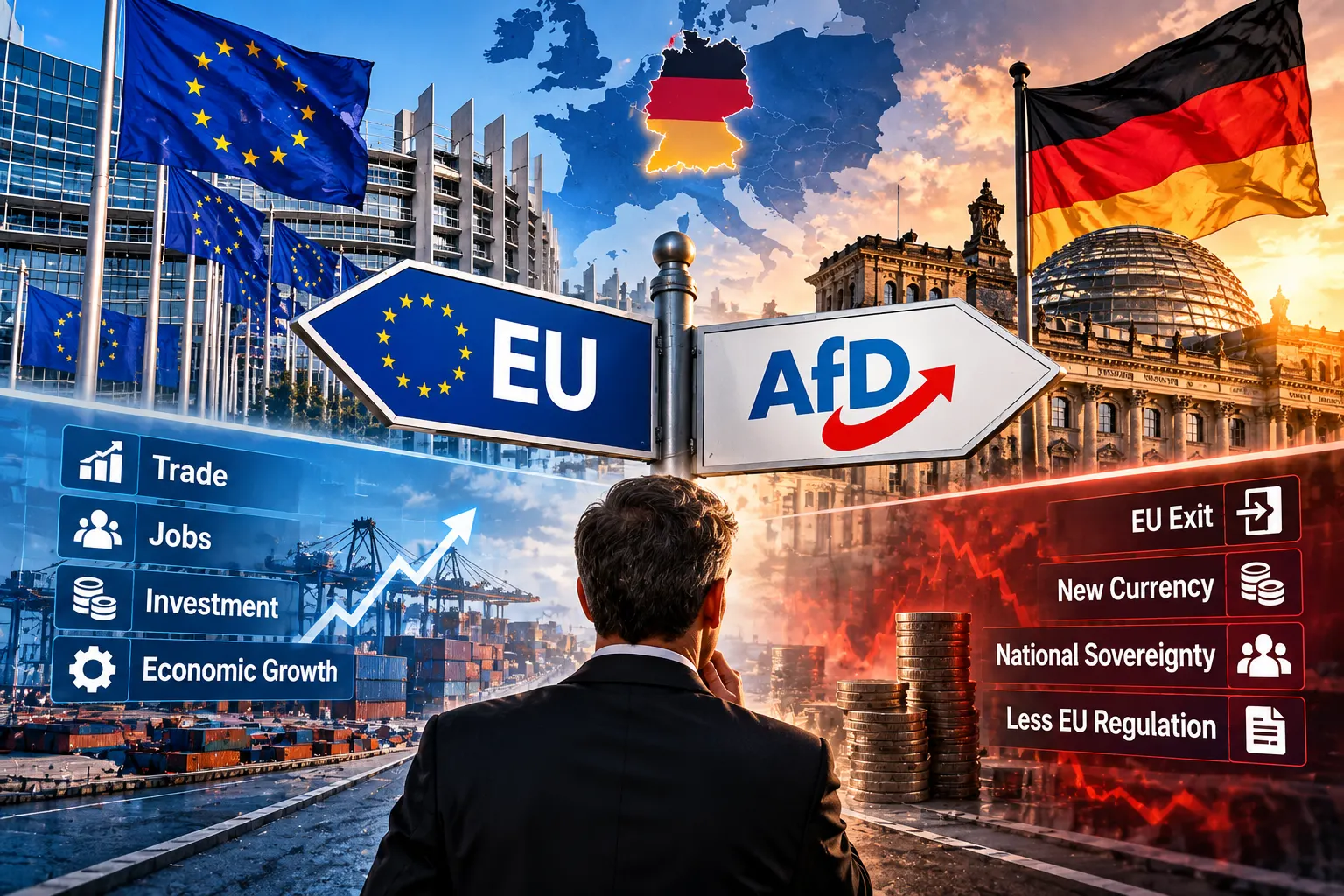
Germany’s Alternative für Deutschland (AfD) wants to strengthen the country’s economy, protect German businesses and restore national sovereignty. Yet its official 2025 general election programme also proposes withdrawing Germany from the European Union, replacing the EU with a new European economic association and leaving the euro currency system. These ambitions raise a fundamental question: can Europe’s largest economy preserve the commercial advantages of European integration while dismantling the institutions that currently provide them?
The question extends beyond Germany. Nationalist and right-wing populist parties across Europe have gained influence by promising stronger national governments, tighter immigration controls, lower regulatory burdens and greater political accountability. Their criticism of EU centralisation frequently overlaps, but their practical proposals differ considerably. Some advocate fundamental institutional reconstruction, others seek changes from within, and parties already exercising governmental power must reconcile their political programmes with existing European obligations.
Comparing these movements reveals tensions between several objectives: national independence and economic integration, unrestricted trade and greater border controls, reduced international commitments and stronger European security, and national decision-making alongside the desire for coordinated European action. Not every tension amounts to a logical contradiction. Some reflect genuine political choices about which objectives should take priority. Others expose practical problems that party programmes do not fully resolve.
The distinction matters because the consequences would extend well beyond political institutions in Brussels. Decisions concerning European integration affect manufacturing, agricultural markets, investment, financial stability, employment, consumer prices and the international influence of European countries. Germany, whose economy is deeply integrated with those of its neighbours, would face particularly consequential choices.
What the AfD Actually Proposes for Europe
The most important starting point is the AfD’s official programme for Germany’s February 2025 federal election, adopted at its party conference in Riesa in January that year. Unlike isolated political speeches or campaign slogans, the document establishes the party’s formal position on a wide range of issues, including European institutions, monetary policy, immigration and international relations.
In its chapter on Europe, the AfD argues that the European Union has developed into an excessively centralised political structure. It contends that EU institutions exercise authority that should belong to democratically elected national governments and that existing arrangements have weakened the independence of member states.
The programme proposes replacing the EU with a new economic and political association, described as a European Economic and Interest Community. This would be organised around sovereign nations cooperating in areas where they identify common interests.
The party identifies the common market, external border protection, strategic security cooperation and the preservation of national cultural identities as potential areas of cooperation. It also acknowledges that an abrupt institutional break could be counterproductive and calls for negotiating a transition with existing European partners.
However, the programme goes beyond advocating ordinary EU reform. It explicitly considers German withdrawal necessary to create the proposed alternative framework. In its monetary policy chapter, it separately calls for Germany to leave the euro system and reintroduce a national currency, potentially alongside a transitional arrangement involving the euro or a European accounting unit.
These proposals should not be conflated. Leaving the euro and leaving the EU are distinct political and legal questions, although they would have substantial economic implications for one another. The party’s stated preference for negotiated arrangements does not establish that other European governments would agree to the proposed terms.
The AfD argues that its approach would restore democratic accountability, reduce regulatory interference and protect Germany from financial liabilities arising from shared European policies. Its critics counter that the proposals could jeopardise the economic integration on which German industry depends.
The decisive issue is therefore not simply whether Germany could legally leave the EU. Article 50 of the Treaty on European Union provides a withdrawal mechanism. The more difficult question is whether a different European structure could reproduce the benefits of the existing one without retaining many of the institutions and shared rules the AfD wants to remove.
European Nationalist Parties Do Not Share a Single Programme
Although nationalist parties frequently cooperate in European politics, their positions on the future of the EU are not identical. Germany’s AfD, France’s Rassemblement National, Italy’s Fratelli d’Italia and Austria’s Freedom Party (FPÖ) all criticise aspects of European integration, but their institutional ambitions and political circumstances differ.
France’s Rassemblement National, associated with Marine Le Pen and Jordan Bardella, advocates a Europe in which national governments exercise substantially greater authority. Its 2024 European election programme opposed further centralisation and defended national control over sensitive areas including immigration and security. However, it did not present withdrawal from the EU and euro as its central immediate electoral strategy.
Italy’s Fratelli d’Italia, led by Prime Minister Giorgia Meloni, also promotes national sovereignty and criticises aspects of EU regulation. Its 2024 European election programme called for a Europe built around cooperation between sovereign states. Yet the party’s governmental approach has involved negotiating within European institutions rather than pursuing Italian withdrawal.
Austria’s FPÖ similarly calls for stronger national sovereignty, tighter immigration policies and a substantial reduction in the influence of EU institutions. Its 2024 European election programme proposed reducing the size and authority of European institutions while emphasising cooperation among independent states.
These examples demonstrate that opposition to greater EU centralisation does not automatically imply support for leaving the Union. Nor does belonging to the same broad nationalist political movement guarantee agreement on economic integration, security policy or the appropriate balance between European and national authority.
Four Nationalist Parties Compared: Their Approaches to Europe
| Party | EU strategy | Principal emphasis |
|---|---|---|
| AfD — Germany | Replace the EU; German withdrawal considered necessary | National sovereignty, new economic association and euro exit |
| Rassemblement National — France | Reshape the EU from within | National decision-making, border control and economic protection |
| Fratelli d’Italia — Italy | Reform European cooperation within existing institutions | National interests, competitiveness and sovereignty |
| FPÖ — Austria | Reduce EU authority and strengthen member states | Immigration restrictions and national political autonomy |
Sources: Official AfD 2025 federal election programme; Rassemblement National, Fratelli d’Italia and FPÖ European election programmes from 2024. The comparison summarises documented programme positions and does not imply that every party’s position has remained unchanged in every detail through October 2026.
The differences become especially important when considering whether these parties could collectively transform the EU. Replacing the existing European treaties would require extensive negotiations and agreement among governments with competing interests. A proposal that benefits one country may create disadvantages for another.
For example, a government seeking greater freedom to subsidise domestic industries may encounter resistance from countries concerned about unfair competition. Another government might favour common European borrowing to finance investment, while a fiscally conservative partner opposes shared liabilities. Both governments can describe their positions as defending national interests, yet those interests may point towards incompatible European policies.
National sovereignty is therefore not a single policy with universally agreed consequences. It is a principle that can produce different and sometimes conflicting demands depending on the country applying it.
The Central AfD Paradox: Wanting a Common Market Without the Existing Union
The AfD’s European programme places particular importance on preserving free trade and economic cooperation. This reflects an economic reality that Germany cannot easily disregard: its prosperity depends heavily on international markets and highly integrated manufacturing networks.
According to Germany’s Federal Statistical Office, Destatis, German businesses exported approximately €1.563 trillion in goods during 2025. Of that amount, roughly €876.5 billion went to other EU member states, representing approximately 56% of total merchandise exports.
These figures illustrate the enormous importance of the European market to German companies. They do not mean that every export would disappear following an EU withdrawal. Countries outside the European Union can maintain extensive trade relationships with European customers. However, market access depends on the agreements, regulatory arrangements and administrative procedures governing those relationships.
The current single market is more than an agreement to reduce customs tariffs. It combines rules governing goods, services, investment, competition, product standards and other economic activities. Common institutions oversee the application of those rules, and judicial mechanisms provide ways to resolve disputes.
A new economic community could theoretically preserve many of these arrangements. But doing so would require participating countries to agree on common standards, enforcement procedures and mechanisms for settling disagreements.
This creates a practical dilemma for parties seeking maximum national independence alongside unrestricted economic integration. If every government can unilaterally disregard common commercial rules, businesses may lose the predictability that makes an integrated market valuable. If governments accept binding common rules, they surrender some of the decision-making autonomy that nationalist parties seek to restore.
Neither outcome is necessarily impossible to manage. International agreements routinely involve compromises between national independence and mutual obligations. Nevertheless, the AfD’s proposed institutional replacement would need to specify which common rules would survive, who would enforce them and how disagreements would be resolved.
Without those details, the claim that Germany could obtain the same economic benefits through a substantially weaker European institutional structure remains an unproven proposition rather than an established economic result.
Germany’s Dependence on European Trade Is Difficult to Ignore
The importance of EU membership is particularly visible in German manufacturing. Automotive companies, chemical producers, machinery manufacturers and thousands of smaller suppliers operate through production networks extending across national borders.
Components may cross several European borders before becoming finished products. Manufacturers depend on coordinated standards, reliable logistics, cross-border investment and predictable regulatory conditions.
Even relatively small administrative changes can create costs when they affect large volumes of trade. Additional customs declarations, certification requirements, regulatory divergence or border delays can impose expenses that accumulate across complex supply chains.
Supporters of greater national autonomy argue that regulatory simplification and more flexible trade arrangements could offset some of these costs. That argument deserves consideration, particularly where existing regulation creates unnecessary administrative burdens.
However, the economic benefit of removing a regulation must be weighed against the consequences if different national rules make cross-border production more difficult. Simplification can improve competitiveness, but regulatory fragmentation can create additional costs.
For Germany, the trade-off is particularly significant because manufacturing businesses often rely on predictable access to several European markets simultaneously.
What Economic Research Suggests About Dismantling European Integration
The possible economic consequences can be examined using research into different forms of European disintegration. Such research cannot predict the exact outcome of an AfD government, particularly because the party proposes negotiating a replacement for existing institutions rather than necessarily ending all European trade cooperation.
A 2023 study by the ifo Institute and EconPol Europe nevertheless provides a useful indication of the economic importance of existing arrangements. Its model estimated that the complete dissolution of the EU’s economic agreements would reduce German GDP per capita by approximately 5.2% relative to the model’s reference scenario.
The same research estimated that dismantling the single market alone would reduce German GDP per capita by 3.6%. A separate scenario involving the dissolution of the eurozone produced an estimated German loss of 0.7%.
These are modelled long-term differences between specified economic arrangements, not predictions of an immediate recession or guaranteed consequences of implementing the AfD programme. The study used a 2014 reference year and examined institutional scenarios that do not precisely reproduce the party’s proposed replacement organisation.
Economic Cost of European Disintegration — Selected ifo Model Scenarios
| Scenario | Germany | France | Austria |
|---|---|---|---|
| Complete dissolution of EU agreements | −5.2% | −4.1% | −7.8% |
| Dissolution of the single market | −3.6% | −3.0% | −5.6% |
| Dissolution of the eurozone | −0.7% | Not specified here | Not specified here |
Source: ifo Institute and EconPol Europe, February 2023. Modelled changes in GDP per capita under different institutional scenarios, using 2014 as the reference year. These figures are not direct forecasts of AfD policies. Values not reproduced here have been left unspecified rather than inferred.
The model demonstrates why the distinction between reducing bureaucracy and dismantling market integration is so important. Economies can benefit from regulatory reform without necessarily abandoning the commercial arrangements that support cross-border trade. Conversely, institutional changes that disrupt those arrangements can create costs even when their stated objective is greater economic freedom.
The AfD maintains that the costs of continuing existing European policies exceed those associated with its proposed alternative. Demonstrating that proposition would require detailed modelling of the replacement system, including market access, financial arrangements, regulatory standards and monetary policy.
Without a comprehensive specification of those arrangements, neither the benefits promised by supporters nor the losses projected under more disruptive scenarios can be treated as inevitable.
Leaving the Euro Would Create a Second Major Economic Transition
The AfD’s demand for a national currency introduces a separate set of challenges. The party argues that monetary sovereignty would allow Germany to pursue policies better suited to its economic circumstances rather than sharing monetary decisions with countries possessing different economic structures.
This argument reflects a genuine debate in monetary economics. A shared currency removes exchange-rate fluctuations between participating countries and facilitates cross-border trade, but it also prevents individual governments from adjusting their national exchange rates or independently setting monetary policy.
The AfD regards the latter limitation as a serious disadvantage. Its programme argues that the euro has encouraged inappropriate financial transfers and exposed German taxpayers to excessive shared liabilities.
Yet reintroducing a national currency would involve difficult questions concerning bank deposits, contracts, public debt, private borrowing, international payments and financial markets. If a new German currency appreciated against the euro, imported goods could become cheaper in the new currency, but German exporters could face reduced international price competitiveness.
A weaker national currency could have the opposite effects. Exchange-rate movements would also influence the domestic value of financial assets and liabilities denominated in foreign currencies.
These outcomes would depend on the legal structure of the transition, financial market expectations and the monetary framework eventually adopted. The current European treaties provide an explicit mechanism for leaving the EU, but not an equivalent straightforward procedure for a member state to abandon the euro while remaining within the existing monetary union.
The AfD acknowledges that currency conversion would entail adjustment costs. However, its assertion that these would be lower than the continuing costs of euro membership remains a political and economic assessment rather than an established outcome.
Stronger Borders and Open Trade: Another Difficult Balance
Immigration is among the most prominent issues connecting right-wing nationalist parties across Europe. The AfD, Rassemblement National and FPÖ all advocate substantially tighter migration controls, although their specific proposals and national circumstances differ.
These positions frequently combine demands for stronger external border enforcement with criticism of existing European migration arrangements. The underlying argument is that national governments should exercise greater authority over who enters and remains within their countries.
Border control and international trade are not inherently incompatible. Many countries maintain strict immigration policies while engaging in extensive cross-border commerce. Nor should controls over the movement of people be automatically equated with customs restrictions on goods.
However, European economic integration involves several interconnected forms of mobility. The free movement of workers supports businesses operating across national borders, while the Schengen system reduces routine internal border checks for participating countries.
Reintroducing systematic internal controls could create costs for commuters, transport operators and businesses that depend on time-sensitive deliveries. The extent would depend on which controls were introduced, how they operated and whether goods and workers continued to benefit from existing legal arrangements.
The effects on labour markets would also differ between industries. Countries experiencing shortages in healthcare, construction, hospitality or specialised manufacturing may need continued access to foreign workers even while pursuing tighter immigration policies.
The AfD’s 2025 programme recognises a role for selected qualified immigration. This demonstrates why its migration policy cannot accurately be characterised as a proposal to end every form of international recruitment. The unresolved economic question concerns whether the scale and composition of migration permitted under its proposed arrangements would meet the needs of employers and public services.
National Sovereignty Can Conflict With Collective European Security
Another area of tension concerns defence and foreign policy. European nationalist parties frequently oppose transferring additional authority to supranational institutions, yet national security increasingly depends on cooperation involving intelligence, defence production, infrastructure and international diplomacy.
Germany’s AfD argues for a foreign policy focused on national interests and has advocated a different relationship with Russia. Its 2025 election programme calls for a new European peace and security framework while criticising aspects of existing Western policy towards Moscow.
The party’s position on Ukraine has also brought it into conflict with governments that favour continued military assistance. On 14 October 2026, AfD representatives joined the left-wing Bündnis Sahra Wagenknecht in supporting a symbolic motion in Saxony-Anhalt calling for an end to German military aid to Ukraine. The regional parliament does not determine national foreign policy, but the vote illustrated an area of agreement between parties otherwise associated with different political traditions.
Supporters of ending military assistance argue that resources should be redirected towards domestic priorities and that negotiations offer a better route to ending the war. Supporters of continued assistance counter that reducing Ukraine’s defensive capabilities could strengthen Russia’s negotiating position and increase future security risks for European states.
Neither position can be evaluated adequately through claims about national interest alone. The relevant questions include the likely effects on the battlefield, the prospects for a sustainable settlement, the cost of deterrence and the implications for neighbouring countries.
National governments can cooperate on security without transferring all defence authority to European institutions. NATO already provides an example of interstate security cooperation. Nevertheless, effective collective defence requires shared commitments and practical coordination, limiting the extent to which every participating government can act entirely independently.
The underlying dilemma is therefore familiar: European nationalist parties often seek stronger national security while resisting some of the institutional arrangements intended to facilitate collective action.
Why France and Italy Have Different Incentives From Germany
Differences between nationalist parties become clearer when their national economic and political circumstances are considered.
Germany’s AfD has developed an explicitly institutional challenge to the EU and euro. Rassemblement National has instead concentrated on changing the balance of authority between France and European institutions, while retaining important elements of European economic integration.
France’s policy debate is influenced by its role as a major agricultural producer, its defence capabilities, its public finances and its substantial domestic market. Its nationalist movement has therefore emphasised protecting domestic economic interests and limiting the authority of European institutions rather than making immediate withdrawal its defining policy.
Italy faces a different set of constraints. Its economy is closely integrated into European trade and finance, and its public debt makes financial stability an important consideration. As head of government, Giorgia Meloni has pursued negotiations within European institutions while continuing to advocate stronger national control over selected policy areas.
There is no automatic contradiction between criticising EU policies and working within EU institutions. Governments frequently seek changes to international organisations of which they remain members.
A genuine inconsistency would arise where a party simultaneously promised incompatible results without explaining the necessary compromises. For example, a government could not independently impose rules that directly conflict with binding common-market obligations while also assuming that every existing market-access benefit would remain unchanged.
The degree of conflict would depend on the particular rules, available exceptions, negotiated reforms and willingness of other governments to cooperate.
Political Promises Are Easier to Combine Than Their Economic Consequences
A recurring feature of nationalist programmes is the simultaneous promise of lower taxes, stronger public services, improved infrastructure and tighter control over public finances. These objectives may each appeal to voters, but their compatibility depends on the available budget, the pace of economic growth and the savings that can realistically be achieved.
The AfD’s 2025 programme proposes substantial tax changes, including abolishing inheritance tax and reducing other forms of taxation. It also emphasises fiscal discipline and stronger economic performance.
These measures could benefit particular households and businesses. Removing inheritance tax, for example, would reduce liabilities for estates otherwise subject to the tax. However, the distribution of benefits would depend on existing allowances, asset values and individual circumstances.
The fiscal question concerns how lost revenue would be replaced or which expenditure would be reduced. A programme can reasonably argue that lower taxation may improve economic incentives, but the resulting growth cannot automatically be assumed to compensate fully for the initial revenue loss.
The same principle applies to proposals to reduce EU contributions. A country could save some direct budgetary payments by changing its relationship with European institutions. However, those savings must be evaluated alongside the economic benefits of integration, funding received from European programmes and the additional administrative or trade costs associated with alternative arrangements.
The ifo Institute’s research on European disintegration illustrates the importance of making this comparison. In its model, the economic losses associated with dismantling EU agreements were considerably greater for Germany than the benefits from ending net fiscal transfers.
These findings do not establish that every proposed reduction in European expenditure would be harmful. They do challenge the assumption that reducing payments to Brussels necessarily increases national prosperity by an equivalent amount.
The Brexit Experience Offers Lessons, Not an Exact Prediction
The United Kingdom’s withdrawal from the European Union provides the most important real-world example of a major European economy leaving the bloc. However, Brexit should not be treated as an exact model for Germany because the two countries have different economic structures and monetary arrangements.
Britain already had its own currency before leaving the EU. Germany, by contrast, would face additional monetary questions if it attempted to implement both an EU withdrawal and a departure from the euro.
Research published by the European Commission in December 2022 found that Britain’s departure from the single market was associated with a persistent reduction in UK imports from the EU relative to imports from other countries. The study estimated a 25% relative decline, while finding a smaller and more temporary effect on British exports to the EU.
These findings demonstrate that new trade arrangements can have measurable effects even when governments negotiate agreements intended to preserve commercial cooperation.
At the same time, Brexit did not end trade between Britain and the European Union. Companies adapted, new arrangements were established and significant economic relationships continued.
The relevant lesson for Germany is therefore neither that withdrawal would inevitably destroy international trade nor that an alternative agreement could automatically reproduce the benefits of membership.
The outcome would depend on the precise agreements negotiated, the resulting regulatory environment and the ability of businesses to adapt.
Would Voters Support the Consequences of an EU Withdrawal?
There is also a distinction between dissatisfaction with European institutions and support for leaving the EU altogether.
An official Eurobarometer survey published in May 2026 found that 74% of respondents in Germany believed their country benefited from EU membership. Across the EU, almost three-quarters expressed the same view.
The survey also found that 71% of German respondents regarded the EU as a source of stability, while 87% supported a common European defence and security policy.
These results do not establish how voters would respond to a detailed referendum concerning institutional reform or withdrawal. A person may believe that EU membership provides benefits while simultaneously favouring substantial changes to European policies.
Nevertheless, the figures reveal an important political constraint. A government proposing fundamental changes to Germany’s European relationship would need to address a population in which substantial majorities recognise benefits from existing cooperation.
Campaign criticism of Brussels should therefore not automatically be interpreted as public endorsement of dismantling European institutions.
Three Different Futures for Europe’s Nationalist Movements
The future influence of nationalist parties will depend partly on whether they can transform broad political demands into workable international agreements.
One possibility is that nationalist parties achieve selected reforms within existing European institutions. These might involve changes to immigration policy, regulatory requirements, spending priorities or the allocation of competences between European and national authorities. Such developments would preserve much of the current economic framework while changing its political operation.
A second possibility involves substantial institutional reconstruction. Governments could negotiate a European system with fewer centralised powers and a greater role for national decision-making. Such an arrangement would require extensive treaty negotiations, agreement on common market rules and solutions to disputes over financing, enforcement and security.
A third scenario would involve one or more countries withdrawing without securing arrangements capable of preserving existing levels of economic integration. This could generate greater national freedom over certain policies but also introduce new trade barriers, financial uncertainty and regulatory complications.
These scenarios are not predictions. Their feasibility would depend on election results, constitutional requirements, public opinion, negotiations and the decisions of other European governments.
For Germany, the economic stakes would be particularly significant because any fundamental change to its EU and euro membership would affect an extensive network of commercial, monetary and political relationships.
The Real Contradiction Is Between Political Simplicity and Economic Complexity
The comparison of European nationalist parties reveals a diverse political movement rather than a single coherent project. These parties frequently agree that national governments should exercise greater authority, but they differ over how European institutions should be reformed, replaced or used to advance national interests.
Germany’s AfD advocates one of the more far-reaching institutional changes among the parties examined. Its proposals seek to combine national monetary sovereignty, reduced European centralisation and a continued common market.
That combination is not logically impossible. However, it would require agreements capable of reconciling national decision-making with the shared obligations necessary for integrated trade and financial stability.
The economic challenge is substantial. German businesses depend heavily on European markets, and independent research indicates that dismantling existing integration could impose significant economic costs. The magnitude of those costs would depend on how much cooperation a replacement system preserved.
Other nationalist parties have adopted different approaches. France’s Rassemblement National and Italy’s Fratelli d’Italia have placed greater emphasis on changing European policies from within existing institutions. Austria’s FPÖ advocates substantially reducing centralised authority without making the immediate replacement of the entire EU its defining European election proposal.
The differences reflect national priorities, political circumstances and the practical limits of cooperation between governments pursuing their own interests.
Europe’s debate over sovereignty is therefore not simply a contest between national independence and European integration. It concerns how much shared authority is necessary to secure the economic, political and security benefits that participating countries want to retain.
For voters evaluating nationalist programmes, the most important questions extend beyond whether particular promises sound attractive. They concern the laws that would need to change, the agreements other countries would have to accept, the economic costs that might arise and the institutions required to make the proposed alternatives function.
Political parties can promise greater sovereignty, lower costs and continued prosperity simultaneously. Whether their policies can deliver all three is a question that must ultimately be answered through detailed proposals, credible economic evidence and the practical consequences of implementation.
Sources
Alternative für Deutschland — Official 2025 Federal Election Programme, adopted January 2025
Alternative für Deutschland — Official Party Programme and European Policy Principles
German Federal Statistical Office — German Foreign Trade Results for 2025, February 2026
Fratelli d’Italia — Official European Election Policy Priorities, May 2024
Fratelli d’Italia — Official European Election Programme 2024
Rassemblement National — Official French Legislative Election Programme, 2024
Rassemblement National — European Election Position and Europe of Nations, May 2024
Freedom Party of Austria — Official European Election Programme 2024
European Union — Treaty on European Union, Article 50: Withdrawal Procedure
European Commission — Eurobarometer Findings on EU Membership and European Security, May 2026
European Commission — UK Trade in the Wake of Brexit, December 2022
Source & Transparency
This article is published by PlanetPress24 for editorial and informational purposes.
Published: 21 October 2026 · Updated: 21 October 2026

PlanetPress24 Newsroom
PlanetPress24 provides independent international news coverage, in-depth analysis and factual reporting on world affairs, politics, business, financial markets, technology, science and society.