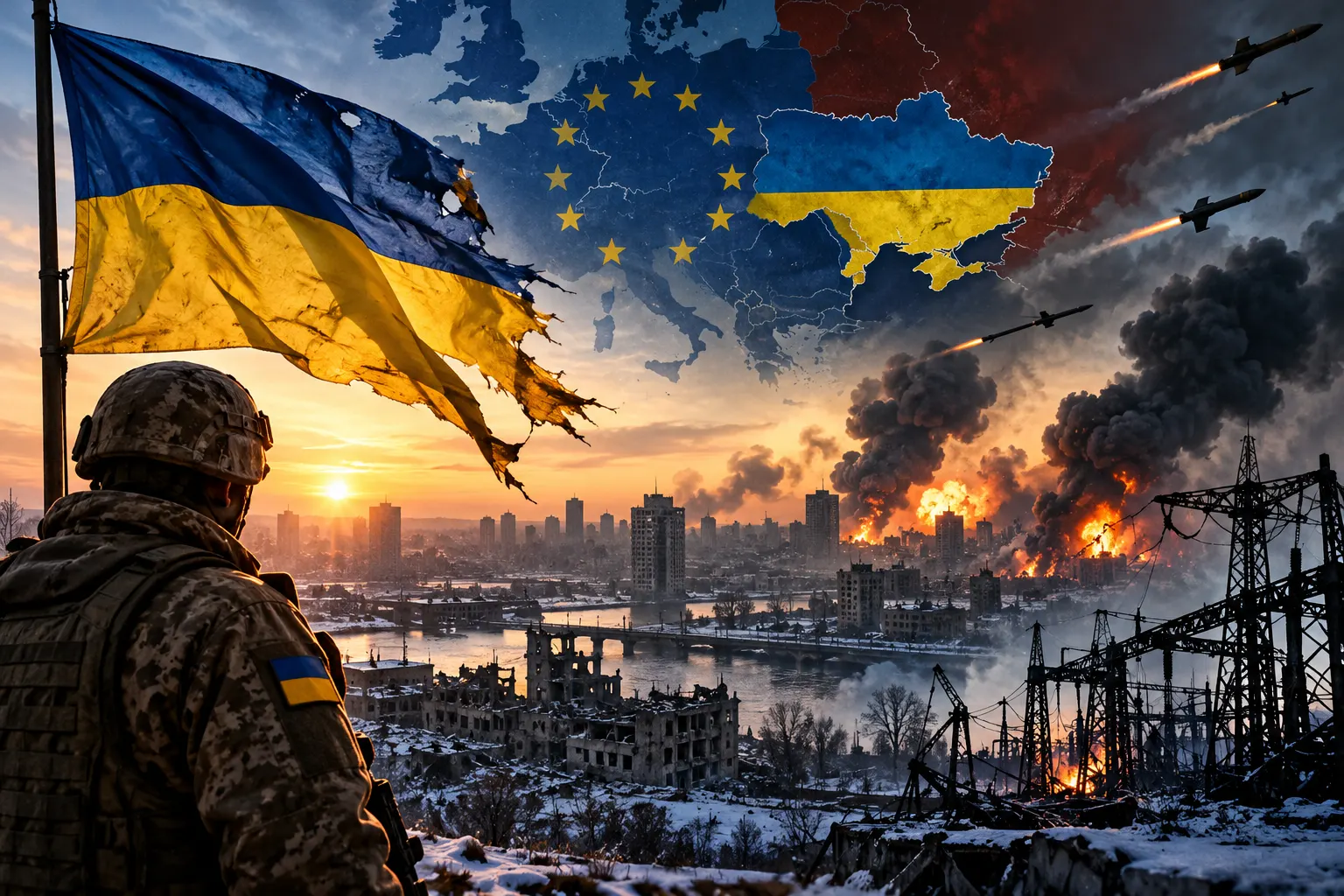
Ukraine is approaching the fifth anniversary of Russia’s full-scale invasion in an increasingly precarious position. Russian missiles and drones continue to strike cities, energy facilities and essential infrastructure, while Ukrainian forces struggle to defend their territory against a much larger adversary. At the same time, tensions between Kyiv and Washington are creating new uncertainty about the military assistance on which Ukraine has depended. For European governments, the consequences extend far beyond the survival of one neighbouring country: the outcome could influence the security architecture of the entire continent for decades.
The central geopolitical reality is becoming increasingly difficult to ignore. Europe has a more direct and immediate strategic interest than any other region in preventing Ukraine from being conquered, politically subordinated or permanently deprived of its independence by military force. A Russian victory would not simply redraw the map of Eastern Europe. It could undermine the principle that European borders cannot legitimately be changed through aggression, strengthen Moscow’s ability to exert pressure on neighbouring states and force European countries to reconsider their own security arrangements.
Yet the proposition that Europe alone wants Ukraine to remain sovereign would go further than the evidence supports. Canada, Japan and other countries outside Europe have also provided assistance or defended Ukraine’s territorial integrity. The distinction is not between a Europe that values Ukrainian independence and a world that does not. It is between a Europe that faces the most immediate geographical and strategic consequences and other international powers whose priorities, interests and willingness to act differ considerably.
Russia’s War Is Entering an Increasingly Dangerous Phase
The humanitarian situation illustrates how profoundly the conflict continues to affect Ukrainian society. According to the United Nations Human Rights Monitoring Mission in Ukraine, at least 328 civilians were killed and 2,105 injured during September 2026. That represents an 85 per cent increase in verified civilian casualties compared with September 2025. The figures cover casualties across 22 Ukrainian regions and the capital, Kyiv, and reflect the continuing danger posed by long-range missiles, attack drones and weapons used near the front line.
Between January and September 2026, UN monitors recorded at least 2,570 civilian deaths and 15,211 injuries. These verified totals were 59 per cent higher than during the corresponding period in 2025. Because verification is difficult in occupied territories and areas affected by intense fighting, the documented figures should not be interpreted as a complete account of the human cost.
The danger is no longer confined to communities immediately adjacent to the battlefield. Long-range weapons accounted for more than half of the verified civilian casualties in September. Residential districts, transport networks and energy infrastructure remain vulnerable even hundreds of kilometres from the front.
On 20 October, another major Russian aerial assault killed at least nine civilians, according to reporting by the Associated Press, and caused damage and electricity disruptions across multiple Ukrainian regions. The attacks coincided with renewed diplomatic efforts involving Ukraine, European governments and the United States.
Ukraine continues to resist militarily, developing its own drone capabilities and targeting infrastructure supporting Russia’s war effort. However, the conflict remains highly asymmetric in several important respects. Russia possesses a larger population, substantial military-industrial resources and the ability to sustain repeated attacks. Ukraine’s defensive capabilities depend on domestic production, mobilisation, international financing and access to sophisticated foreign weapons systems.
Neither Ukraine’s continued resistance nor Russia’s substantial military resources makes the eventual outcome inevitable. Battlefield developments, military production, political decisions and the availability of external assistance will all influence how the conflict evolves.
Energy Infrastructure Has Become a Critical Front in the War
One of Ukraine’s most immediate challenges is maintaining electricity, heating and other essential services as another winter approaches. Russian attacks on power generation and transmission facilities threaten not only the functioning of the economy but also the everyday survival of civilians, particularly during periods of extreme cold.
A United Nations report published in June 2026 documented at least 423 Russian attacks on electricity generation, transmission and distribution facilities between October 2025 and March 2026. It also recorded at least 74 strikes against combined heat and power plants and other heating infrastructure during that period.
The destruction has consequences extending well beyond temporary power cuts. Hospitals require reliable electricity for life-saving equipment, water systems depend on pumping stations, and businesses need predictable energy supplies to maintain production. Repeated damage can also exhaust repair budgets, disrupt employment and accelerate the departure of skilled workers.
The military implications are equally significant. A state forced to devote increasing resources to repairing infrastructure has fewer resources available for other priorities. Energy disruption can weaken industrial production, complicate logistics and place additional pressure on public finances.
For Russia, pressure on Ukrainian infrastructure forms part of a broader strategy of attrition. For Ukraine, the ability to preserve essential services has become an important measure of national resilience. International humanitarian law prohibits deliberate attacks on civilians and civilian objects, while attacks on facilities with a military function remain subject to strict rules concerning distinction, proportionality and precautions.
Why Europe’s Security Is Directly Connected to Ukraine’s Independence
Ukraine occupies a strategically important position between the European Union, NATO member states, Russia and the Black Sea. Its territory, infrastructure and political orientation influence regional trade, military geography, energy networks and access to important transport routes.
If Russia succeeded in placing Ukraine under its effective political control, European governments would confront a substantially altered security environment. Moscow could gain greater strategic depth, additional leverage over Black Sea access and potentially greater freedom to pressure neighbouring countries.
The consequences would be especially significant for Poland, Romania and the Baltic states, where concerns about Russian military power already play an important role in defence planning. A successful campaign of territorial conquest could also encourage the perception that sustained military pressure can eventually overcome international opposition.
That does not mean a Russian victory in Ukraine would automatically lead to attacks on NATO territory. Such an outcome would depend on political decisions, military capabilities and the credibility of NATO’s collective defence arrangements. Nevertheless, the potential security consequences explain why European governments view Ukrainian independence as more than a matter of solidarity.
Europe’s interest is also economic. The war has disrupted agricultural production, transport networks, investment and energy markets. It has increased defence expenditure and contributed to an extensive reorganisation of European security and industrial priorities.
A Ukraine deprived of meaningful independence could generate prolonged instability on the European Union’s eastern frontier. Such instability might involve renewed displacement, restrictions on trade, pressure on neighbouring states and continuing demands for military deterrence.
From this perspective, supporting Ukraine is not simply an act of assistance to a country under attack. It is also an investment in a European security order in which sovereign states retain the right to determine their own future without being subjected to military coercion.
Europe Has Become Ukraine’s Principal International Financial Backer
The growing importance of European assistance is supported by research from the Kiel Institute for the World Economy, which maintains the Ukraine Support Tracker, a database documenting international military, financial and humanitarian assistance.
Its August 2026 analysis found that Europe had become the largest provider of military assistance to Ukraine. European institutions also allocated substantial additional support during May and June through the European Union’s Ukraine Support Loan, designed to finance Ukrainian budgetary and defence requirements in 2026 and 2027.
However, Europe’s growing financial responsibility does not mean it has achieved military independence from the United States. The same research found that American-produced weapons remained essential to European assistance programmes.
During the first six months of 2026, European donors purchased at least €3 billion in military equipment from American defence manufacturers. This represented approximately 30 per cent of European military aid provided through defence-industry procurement during that period.
More than 90 per cent of the military assistance supplied through NATO’s Prioritised Ukraine Requirements List mechanism came from American stockpiles, according to the institute’s assessment.
These figures expose an important strategic vulnerability. European governments may be willing to finance weapons for Ukraine, but certain critical systems remain dependent on American manufacturing capacity, inventories, export authorisations and political decisions.
The European Council reaffirmed its support for Ukraine’s independence, sovereignty and internationally recognised borders on 16 October 2026. Its conclusions committed the European Union to continuing political, economic, humanitarian, military and diplomatic support.
European governments nevertheless face difficult choices concerning defence production, public expenditure and the distribution of financial responsibility. Maintaining assistance over several years requires more than political declarations. It requires reliable funding, industrial capacity and sustained agreement among governments with different economic and domestic political priorities.
Washington’s Changing Approach Is Creating a Strategic Dilemma
For much of the full-scale war, American military technology, intelligence and financial assistance played a decisive role in Ukraine’s ability to resist Russia. That relationship has become increasingly strained under President Donald Trump’s administration.
In October 2026, disagreements intensified over American sanctions policy, Ukrainian strikes against Russian energy facilities and the delivery of essential military equipment.
President Volodymyr Zelenskyy has expressed concern about delayed deliveries of air-defence interceptors, disruptions affecting satellite communications and the availability of advance warning information concerning Russian missile attacks.
American Secretary of State Marco Rubio acknowledged on 20 October that missile interceptors intended for Ukraine might not have been delivered, but rejected the suggestion that any such delay was politically motivated.
This distinction matters. Ukrainian concerns about the practical consequences of delayed assistance are supported by the existence of delivery problems, but allegations that particular restrictions were deliberately imposed to pressure Kyiv require separate evidence. Official American explanations and Ukrainian assessments should not be treated as interchangeable facts.
The diplomatic strain has become particularly visible as Washington explores renewed engagement with Moscow. Recent American decisions easing certain Russia-related economic restrictions have raised concerns among European officials that the pressure on the Kremlin could weaken before an acceptable settlement has been reached.
The United States has interests extending well beyond Eastern Europe. Its government must consider relations with China, developments in the Middle East, energy markets, domestic political pressures and wider military commitments.
None of these considerations necessarily implies that American policymakers want Ukraine to lose its independence. They do, however, help explain why Washington’s approach may differ from that of European governments that regard Russian military expansion as an immediate regional security threat.
For Ukraine, the danger is that American diplomatic priorities and European security priorities may become increasingly difficult to reconcile.
Why Europe’s Commitment Is Not Entirely Matched Elsewhere
The international response to Russia’s invasion reveals substantial differences between formal diplomatic positions and the willingness of governments to accept economic or military costs.
Countries outside Europe have recognised Ukraine’s sovereignty and supported its defence. Canada, for example, reaffirmed its commitment to Ukrainian independence and territorial integrity in February 2026, highlighting its military, economic, development and humanitarian assistance.
Japan has also contributed financially. According to the Kiel Institute, Tokyo allocated approximately €1.1 billion in March and April 2026 through a financing mechanism supported by proceeds associated with frozen Russian assets.
These contributions demonstrate why it would be inaccurate to claim that Europe is the only part of the world interested in Ukraine’s survival as an independent state.
Yet geography creates a clear difference in strategic urgency. A Russian military victory would change Europe’s immediate security environment. Canada, Japan and other partners would face important diplomatic and strategic consequences, but not the same direct geographical exposure.
Other major powers approach the war through different calculations. China has extensive economic and diplomatic relationships with Russia while also maintaining trade relations with European countries. Beijing’s priorities include regional stability, commercial interests and its wider geopolitical position. Its approach cannot be reduced to a straightforward commitment to either Ukrainian victory or Russian territorial ambitions.
India similarly maintains longstanding defence and economic relationships with Moscow while developing partnerships with Western governments. Energy security, strategic autonomy and relations with competing international powers influence its decisions.
Many countries in Africa, Asia and Latin America place particular emphasis on economic stability, food security, energy prices and the effects of geopolitical confrontation. Their governments do not necessarily interpret the conflict through the same immediate security concerns that dominate debate in European capitals.
These differences do not invalidate Ukraine’s internationally recognised sovereignty. Rather, they demonstrate that diplomatic recognition, economic interests and willingness to bear the costs of supporting another country’s defence are distinct questions.
The strongest evidence-based conclusion is therefore that Europe has the most immediate and concentrated strategic interest in ensuring Ukraine remains independent, while the wider international community contains governments with varying levels of commitment and different priorities.
The United Nations Vote Reveals a Wider International Divide
The international community’s position is more complicated than a simple division between supporters and opponents of Ukraine.
On 24 February 2026, the fourth anniversary of Russia’s full-scale invasion, the United Nations General Assembly adopted a resolution supporting a lasting peace in Ukraine. The resolution reaffirmed Ukraine’s sovereignty, independence and territorial integrity within its internationally recognised borders.
Of the countries participating in the vote, 107 supported the resolution, 12 opposed it and 51 abstained. The United States and China were among those that abstained.
The result is significant for two reasons. First, it demonstrates that support for Ukrainian sovereignty extends well beyond Europe. Second, the considerable number of abstentions illustrates the limits of international consensus over how the conflict should be resolved.
A vote in the General Assembly is not equivalent to a commitment to provide weapons or financial assistance. Nor does abstention necessarily imply support for Russian territorial claims. Governments may abstain because of disagreements over diplomatic language, negotiating strategies or particular provisions.
Nevertheless, the vote highlights a central weakness in Ukraine’s international position: broad recognition of a country’s sovereignty does not automatically translate into effective collective action to defend it.
For European governments, that gap between diplomatic principles and practical assistance has become an increasingly important concern.
Russia’s Objectives and the Limits of a Negotiated Settlement
Russia’s full-scale invasion began on 24 February 2022, following its occupation and purported annexation of Crimea in 2014 and years of conflict in eastern Ukraine. Moscow has repeatedly sought to justify its actions through security arguments, opposition to NATO enlargement and claims concerning Russian interests in Ukrainian territory.
These explanations represent the Russian government’s stated positions. They do not establish a legal justification for invading another sovereign state or acquiring its territory through force.
The United Nations Charter prohibits the threat or use of force against the territorial integrity or political independence of states, subject to recognised exceptions such as self-defence. Russia’s territorial claims over occupied Ukrainian regions have not acquired general international recognition.
Russia has pursued military objectives while continuing to demand political and security arrangements that Kyiv considers incompatible with its independence. Ukraine, meanwhile, maintains that a sustainable settlement must preserve its sovereignty and provide credible protection against renewed aggression.
There is an important distinction between ending active hostilities and establishing a durable peace. A ceasefire could reduce casualties and create opportunities for negotiation, but it would not automatically resolve territorial disputes, security guarantees or the political future of areas under Russian occupation.
A settlement that leaves Ukraine vulnerable to another invasion could postpone rather than resolve the underlying conflict. Conversely, negotiations that disregard Russia’s capacity to continue military operations could fail to produce an enforceable agreement.
European governments must therefore balance several objectives: reducing civilian suffering, preventing military escalation, maintaining international law and ensuring that any negotiated arrangement does not create an even more dangerous security environment.
That challenge becomes more difficult when the United States and European governments disagree over the acceptable terms, sequencing or enforcement of a potential settlement.
The Economic Destruction Will Affect Ukraine for Generations
Beyond the immediate military and diplomatic crisis, Ukraine faces an enormous reconstruction challenge.
In February 2026, a joint assessment by the Ukrainian government, World Bank, European Commission and United Nations estimated the country’s recovery and reconstruction requirements at almost $588 billion over the following decade.
Crucially, this estimate was based on damage and needs assessed up to 31 December 2025. It does not fully account for destruction caused during 2026, including subsequent attacks on energy infrastructure and residential areas.
The assessment estimated direct physical damage at more than $195 billion. Housing, transport and energy infrastructure were among the most severely affected sectors. By the end of 2025, approximately 14 per cent of Ukraine’s housing stock had been damaged or destroyed, affecting more than three million households.
The economic consequences are broader than the reconstruction bill itself. Ukraine must address population displacement, workforce shortages, disrupted education, damaged agricultural land, pressure on public finances and the challenges of maintaining investment during wartime.
Rebuilding roads, hospitals and power stations will require considerable resources. Restoring economic confidence, attracting businesses and encouraging displaced citizens to return could prove equally demanding.
For Europe, Ukraine’s economic future also has direct implications. A functioning and increasingly integrated Ukrainian economy could contribute to regional trade, agricultural production, manufacturing and long-term economic stability. A severely weakened economy would instead remain dependent on extensive external support.
The strategic and economic arguments for Ukrainian independence are therefore closely connected. A sovereign Ukraine with functioning institutions and a viable economy would be better positioned to maintain its security and determine its political future.
Europe Cannot Assume That American Support Will Remain Constant
The deterioration in relations between Washington and Kyiv has exposed a broader weakness in Europe’s security architecture: European countries remain dependent on capabilities that they do not fully control.
American air-defence systems, satellite services, intelligence capabilities and specialised military equipment have played important roles in Ukraine’s defence. Replacing these capabilities would require substantial investment, technical development and time.
Europe possesses considerable economic resources and a sophisticated defence industry, but financial capacity cannot immediately resolve shortages of complex equipment. Manufacturing advanced interceptors, expanding production lines and developing independent communications and surveillance capabilities are long-term industrial challenges.
This creates a potentially consequential imbalance. European governments may regard the preservation of Ukrainian independence as a fundamental security priority while remaining reliant on decisions taken in Washington to achieve it.
There are also political limitations within Europe itself. European Union member states differ in their assessments of Russia, their willingness to finance military assistance and the domestic political costs associated with supporting Ukraine.
Some governments favour extensive long-term military commitments. Others place greater emphasis on negotiation, fiscal restraint or maintaining economic relationships that could be affected by sanctions.
These disagreements do not eliminate Europe’s common security interests, but they complicate collective action.
If the United States reduces its involvement further, European governments will face difficult questions about the scale of assistance they can sustain, the speed at which they can expand defence production and the political agreements necessary to finance these efforts.
Such choices could influence not only Ukraine’s ability to resist Russia but also the future distribution of responsibility within NATO.
Three Possible Paths for Ukraine’s Future
Ukraine’s future remains uncertain, and no responsible assessment can claim that a particular military or diplomatic outcome is inevitable. Nevertheless, three broad scenarios illustrate the choices confronting Kyiv and its international partners.
Continued Resistance With Sustained European Assistance
In the first scenario, European governments maintain substantial military and financial support, while Ukraine continues developing domestic weapons production and defensive capabilities.
Under these conditions, Kyiv could preserve its independence and continue resisting Russian efforts to expand territorial control. Improved air defences, reliable financing and stronger industrial partnerships could reduce some of Ukraine’s vulnerabilities.
However, continued resistance would not necessarily produce rapid territorial gains or bring the war to an early conclusion. A prolonged conflict could impose severe additional human and economic costs on both sides.
A Negotiated Settlement With Credible Security Guarantees
A second scenario involves a ceasefire followed by negotiations addressing security arrangements, monitoring mechanisms and unresolved territorial questions.
Such an agreement could reduce civilian casualties and create opportunities for economic recovery. Its sustainability would depend heavily on whether Ukraine retained meaningful independence and whether credible mechanisms existed to deter renewed attacks.
Any agreement would also face difficult questions concerning occupied territory, displaced populations, prisoners of war, reconstruction responsibilities and accountability for violations of international law.
A ceasefire should therefore not automatically be interpreted as a comprehensive peace settlement.
Declining International Support and Growing Russian Pressure
The third scenario is more dangerous for Ukraine. If essential military deliveries decline while Russia maintains or increases its operational pressure, Kyiv could face worsening shortages of air-defence missiles, ammunition and other critical capabilities.
Further territorial losses, intensified infrastructure destruction and increased economic instability could follow. In such circumstances, Ukraine might experience growing pressure to accept negotiations from a weakened position.
This outcome would carry wider implications for Europe, particularly if military aggression were perceived to have succeeded in forcing substantial political concessions.
However, reduced assistance would not automatically produce Ukraine’s collapse. The resilience of Ukrainian institutions, domestic military production, Russian losses and wider battlefield developments would remain important variables.
The Fundamental Question Is Larger Than Ukraine
The war has become a test of whether the international system can effectively uphold the sovereignty of a state confronted by a more powerful neighbour.
For Ukraine, independence is an immediate question of national survival, political self-determination and the ability of its population to determine its future.
For Europe, the consequences are particularly direct. A settlement that legitimises territorial conquest could weaken regional security, increase pressure on neighbouring states and accelerate a prolonged military confrontation between Russia and European countries.
For the United States, the conflict forms part of a wider set of global strategic priorities. Washington retains important interests in European security, the credibility of international alliances and the prevention of further military escalation, but the weight attached to these interests can change between administrations.
For other international powers, the conflict raises questions about sovereignty, territorial integrity, trade, diplomacy and the stability of the international order. Their willingness to translate these concerns into direct assistance varies considerably.
The central distinction is therefore between having an interest in Ukrainian sovereignty and being prepared to make sustained political, economic and military commitments to defend it.
Europe currently faces the strongest immediate geographical and strategic incentives to make those commitments. That reality explains why European governments have increasingly assumed responsibility for Ukraine’s financing and defence, even as they continue to depend on important American military capabilities.
Yet Europe’s own security calculations should not obscure Ukraine’s agency. The future of the country is not simply a matter for negotiation between Moscow, Washington and European capitals. Ukraine is a sovereign state whose population and government have their own political objectives, security requirements and rights under international law.
Any sustainable peace must take those realities into account.
The decisive question over the coming years will be whether Ukraine and its international partners can establish conditions under which Russian military pressure no longer threatens the country’s independent existence.
Europe has the most immediate strategic reasons to prevent that outcome from being decided by Russian military force. But the principles at stake extend far beyond Europe: whether sovereign states can preserve their independence, whether territorial conquest can be rewarded and whether international agreements can provide meaningful protection against renewed aggression.
Ukraine’s future will consequently help determine more than the security of Eastern Europe. It will influence the credibility of the international rules governing relations between states and the extent to which military power can override them.
Sources
- United Nations Human Rights Monitoring Mission in Ukraine — Protection of Civilians in Armed Conflict, September 2026, published 15 October 2026
- United Nations in Ukraine — Civilian Casualties and Intensifying Attacks on Energy Infrastructure, 16 October 2026
- United Nations — Human Rights Report on Attacks Against Ukrainian Energy Infrastructure, 29 June 2026
- European External Action Service — European Council Conclusions on Ukraine, 16 October 2026
- Kiel Institute for the World Economy — Ukraine Support Tracker: Europe Leads on Aid, US Weapons Remain Key, 13 August 2026
- World Bank — Updated Ukraine Recovery and Reconstruction Needs Assessment, 23 February 2026
- Government of Canada — Reaffirmation of Support for Ukraine’s Sovereignty and Territorial Integrity, 24 February 2026
- United Nations General Assembly — Resolution ES-11/10: Support for Lasting Peace in Ukraine, adopted 24 February 2026
- Associated Press — Russian Aerial Attacks and Diplomatic Talks in Norway, 20 October 2026
- Reuters — US Secretary of State Marco Rubio Addresses Delayed Ukrainian Air-Defence Deliveries, 20 October 2026
- Reuters — Zelenskiy’s Diplomatic Talks Amid Strained US-Ukraine Relations, 20 October 2026
Source & Transparency
This article is published by PlanetPress24 for editorial and informational purposes.
Published: 20 October 2026 · Updated: 20 October 2026

PlanetPress24 Newsroom
PlanetPress24 provides independent international news coverage, in-depth analysis and factual reporting on world affairs, politics, business, financial markets, technology, science and society.