
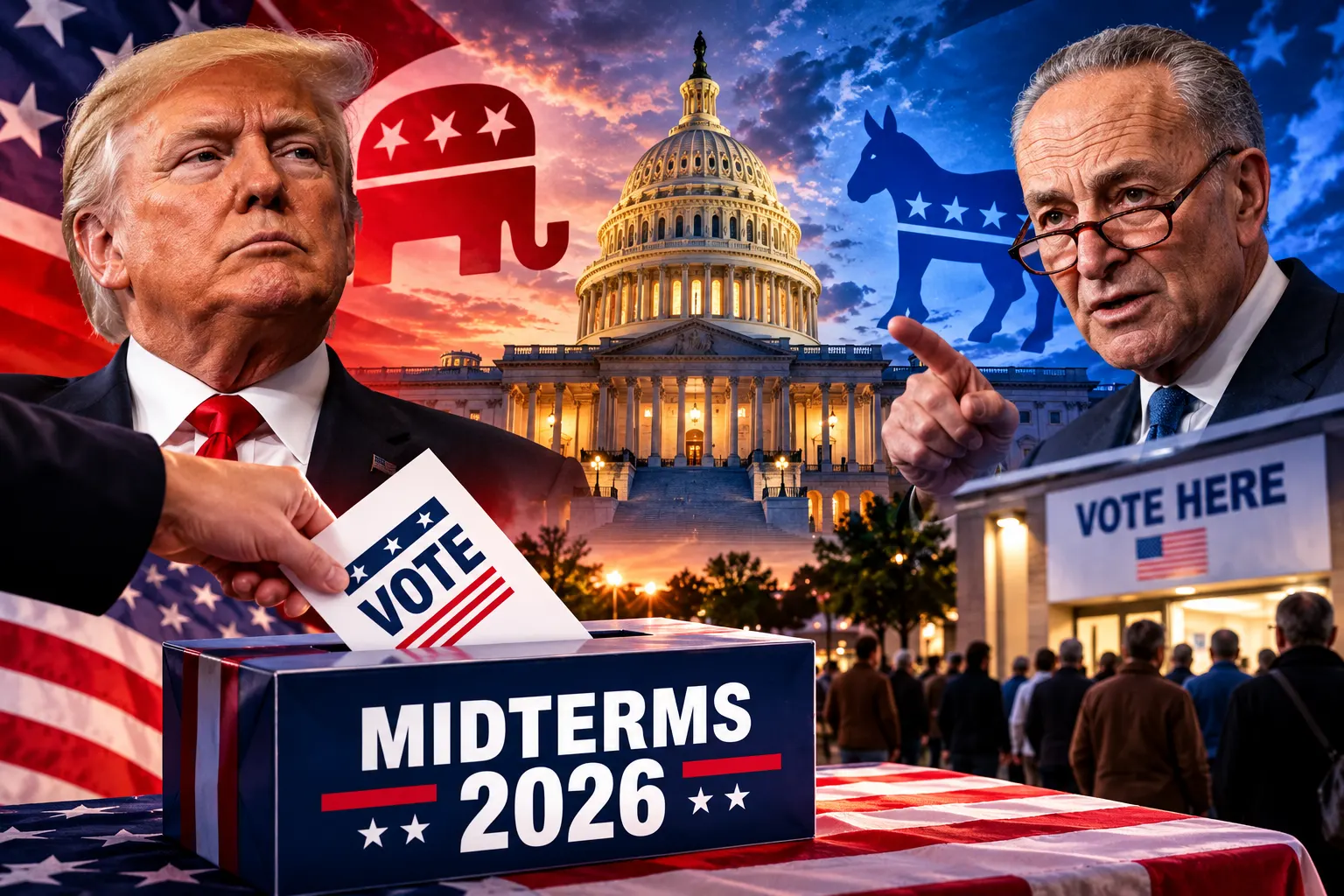
On 3 November 2026, American voters will decide whether President Donald Trump retains a Republican-controlled Congress or faces a substantially more powerful Democratic opposition during the final two years of his presidency. The election comes at a particularly difficult moment for the White House. A Reuters/Ipsos survey published on 19 October placed Trump’s approval rating at just 31%, the lowest recorded during his political career, while Democrats led Republicans by 47% to 35% in a nationwide congressional voting-preference question.
Those figures represent a dramatic political challenge for a president who returned to the White House in January 2025 promising economic prosperity, lower prices, stronger borders, reduced international conflicts and fundamental changes to the federal government. Some of those commitments have produced substantial policy changes. Others remain incomplete, have been restricted by courts or have collided with developments that contradict the administration’s original expectations.
The contest is also taking place against an unusually complicated political background. The United States is involved in a costly conflict with Iran, American households remain concerned about fuel prices and everyday expenses, and the administration faces growing questions about immigration enforcement, presidential powers and the handling of records connected to the late sex offender Jeffrey Epstein.
For Republicans, the election is an opportunity to preserve the congressional majorities needed to advance Trump’s programme. For Democrats, it offers a chance to constrain presidential authority, investigate administration decisions and influence federal spending and legislation. The consequences will depend on which party controls each chamber, because American midterm elections do not directly determine who occupies the White House.
What Americans Will Actually Decide on 3 November
All 435 voting seats in the US House of Representatives are scheduled for election, alongside 35 of the Senate’s 100 seats, including two special elections. Numerous states will also elect governors, state legislators and other officials whose responsibilities extend from public education and healthcare to election administration.
Republicans enter the final campaign period controlling both chambers of Congress, although their majorities are narrow. Democrats need a net gain of four seats in the House and four in the Senate to obtain majorities under the current balance of seats.
The different electoral systems make the two contests difficult to predict using national polling alone. House members represent individual congressional districts, while senators are elected statewide. A substantial Democratic lead in national voting preferences could translate into a House majority without necessarily producing enough victories in competitive Senate states.
Republicans also benefit from the geographic distribution of some of their support, while Democrats face the challenge of winning in states that have historically favoured Republican candidates. Candidate quality, turnout, campaign financing and local issues will influence the final results.
Several Senate races have attracted particularly intense attention, including contests in North Carolina, Ohio, Maine, Michigan and Texas. These elections will help determine whether the Republican Party retains control of appointments and Senate legislative procedures.
Early voting is already under way in several states. The result will therefore depend not only on changing public opinion but also on whether supporters of each party actually cast ballots.
Four Possible Election Outcomes — and What They Would Mean
The simplest distinction between Republican victory and Democratic victory conceals four different institutional possibilities. Because the House and Senate are elected separately, either party could control one chamber while losing the other.
How the Midterm Results Could Change Washington
| Election outcome | Political consequence | Practical implications |
|---|---|---|
| Republicans retain both chambers | Continued Republican congressional control | Greater opportunity to advance Trump’s legislative agenda |
| Democrats win the House only | Divided Congress | Democratic investigations and stronger resistance to legislation |
| Democrats win the Senate only | Divided Congress | Greater Democratic influence over appointments and Senate legislation |
| Democrats win both chambers | Full Democratic congressional control | Substantial constraints on Trump’s legislative agenda and stronger oversight |
Source: United States constitutional arrangements and congressional procedures. The scenarios describe possible institutional outcomes, not election forecasts.
If Republicans retain both chambers, Trump would have a considerably stronger opportunity to pursue additional tax legislation, spending changes, immigration measures and other congressional priorities. Even then, success would not be guaranteed. Narrow majorities, disagreements among Republicans, Senate procedural rules and judicial review could still restrict what the administration achieves.
If Democrats win the House but Republicans retain the Senate, Democratic representatives could use committee investigations, hearings, subpoenas and budget negotiations to challenge administration policies. The Republican-controlled Senate would continue to play the central role in confirming many presidential nominees.
A Democratic Senate with a Republican House would create a different balance. Democrats could exert greater influence over judicial and executive appointments, while legislation would still need to pass both chambers before reaching the president.
If Democrats capture both chambers, the legislative environment would change substantially. Democratic leaders could block many Republican proposals, initiate extensive investigations and seek changes to spending priorities. However, Trump would remain president, retain executive powers and possess the ability to veto legislation.
Congress can override a presidential veto only with a two-thirds majority in both chambers. Ordinary Democratic majorities would therefore not allow the party to implement its entire programme without presidential cooperation.
Similarly, Democratic control would not automatically remove Trump from office. Impeachment begins in the House, but removing a president requires a two-thirds vote in the Senate following a trial. Those are constitutionally distinct decisions from winning congressional majorities.
Trump’s Approval Rating Has Fallen to a Critical Level
The latest Reuters/Ipsos polling illustrates the scale of Republican difficulties. In the survey conducted from 16 to 19 October 2026, only 31% of respondents approved of Trump’s job performance.
The poll also found substantial dissatisfaction with his economic management. Approximately 33% approved of his handling of the economy, while 68% disapproved. The figures are particularly important because inflation, living costs and economic security featured prominently in Trump’s successful 2024 campaign.
Democrats led Republicans by 12 percentage points in the survey’s nationwide congressional voting-preference question, with 47% supporting Democratic candidates and 35% supporting Republicans.
The survey included 1,679 American adults, of whom 1,279 were registered voters. Reuters/Ipsos reported a margin of error of approximately two percentage points for the full adult sample and three percentage points for registered voters.
America’s Political Mood Before the Midterms
| Polling indicator | Result |
|---|---|
| Trump overall approval | 31% |
| Approval of Trump’s economic management | 33% |
| Disapproval of his economic management | 68% |
| Democratic congressional preference | 47% |
| Republican congressional preference | 35% |
Source: Reuters/Ipsos poll conducted 16–19 October 2026 and published 19 October 2026. Job approval and congressional voting preference are separate survey questions with different interpretation requirements.
These findings indicate a difficult political environment for Republican candidates, but they do not constitute an election result. National preferences can differ substantially from the outcomes in individual congressional districts and states. The results may also change as undecided voters make their decisions and party organisations intensify their final campaign efforts.
An Associated Press-NORC survey published in October similarly found widespread dissatisfaction with the direction of the country. Approximately three-quarters of Democratic voters considered participation in the election extremely important, compared with about three-fifths of Republican voters.
The difference in enthusiasm could matter in closely contested races. Midterm results often depend heavily on which groups participate rather than simply which party enjoys the highest approval rating in national surveys.
The Cost of Living Has Become Trump’s Greatest Political Vulnerability
Trump returned to office promising to improve Americans’ purchasing power and reverse the economic dissatisfaction that characterised the final years of Joe Biden’s presidency. His campaign repeatedly emphasised lower energy prices, cheaper groceries, stronger domestic production and improved economic opportunities.
By October 2026, the political environment had become significantly more difficult. The American military campaign against Iran, launched in February alongside Israel, contributed to higher energy prices and renewed concerns about household expenses.
Gasoline prices are particularly politically sensitive because motorists encounter them repeatedly and because energy costs influence transport, agriculture and other sectors. Rising fuel prices can therefore affect perceptions of economic management even when other indicators remain comparatively resilient.
The Reuters/Ipsos findings suggest that dissatisfaction has spread beyond traditional Democratic voters. In a September survey, Republican approval of Trump’s overall performance had fallen from 86% in January 2026 to 73%. Republican approval of his handling of the cost of living fell from 70% to 44% over the same broad comparison period.
These changes provide measurable evidence of weakening support within Trump’s own party. They do not prove that every dissatisfied Republican intends to vote Democratic. Some may support Republican congressional candidates while disapproving of particular presidential decisions; others may abstain.
The distinction could be decisive. For Republicans, the danger is not limited to voters switching parties. Reduced enthusiasm among previously reliable supporters could also determine close elections.
Trump’s Campaign Promises: What Has Been Delivered?
Trump’s 2024 presidential campaign included an extensive collection of commitments concerning immigration, taxation, economic policy, energy, international relations and federal institutions. Evaluating their implementation requires distinguishing between policy announcements, executive orders, enacted legislation and measurable results.
A president can order an agency to pursue a policy without achieving the promised outcome. Similarly, a government can pass legislation that implements part of a campaign proposal while leaving significant elements unresolved.
PolitiFact’s MAGA-Meter tracks 75 identifiable commitments from Trump’s second presidential campaign. Its February 2026 assessment concluded that the administration had achieved a substantial part of its domestic agenda, including major immigration measures and tax legislation, but that numerous promises remained incomplete, modified or blocked.
For a practical overview, the following table groups the principal commitments into categories. It is not a claim to reproduce every statement Trump made during the campaign. The status descriptions reflect documented developments through October 2026 and distinguish implementation from the achievement of promised results.
Trump’s Major 2024 Campaign Promises — Status in October 2026
| Campaign commitment | Status | Assessment |
|---|---|---|
| Reduce crossings at the southern border | Substantially implemented | Border apprehensions fell sharply following major policy changes |
| Carry out mass deportations | Partly implemented | Enforcement expanded; the full promised scale remains unresolved |
| End birthright citizenship for certain children | Legally contested | Executive action faced substantial constitutional challenges |
| Introduce extensive import tariffs | Implemented, with restrictions | Tariff measures introduced; important legal and policy disputes followed |
| Extend major tax reductions | Substantially implemented | Republican tax-and-spending legislation enacted |
| Eliminate federal income tax on tips | Partly implemented | Targeted deductions introduced, subject to eligibility rules and limits |
| End taxation of Social Security benefits | Not fully delivered | Additional deductions do not amount to complete elimination of taxation |
| Reduce grocery and household prices | Not achieved as broadly promised | Affordability remains a major source of public dissatisfaction |
| Lower energy prices dramatically | Not achieved as promised | The Iran conflict contributed to substantial new energy-price pressure |
| Expand American fossil-fuel production | Policy measures implemented | Permitting and regulatory priorities changed; outcomes vary |
| Withdraw from the Paris climate agreement | Implemented | The administration initiated withdrawal after returning to office |
| Withdraw from the World Health Organization | Implemented through withdrawal process | The administration pursued termination of US participation |
| Reduce federal bureaucracy | Partly implemented | Agency restructuring and workforce changes advanced, with legal challenges |
| Close the Department of Education | Not fully delivered | Executive restructuring cannot by itself repeal the department’s statutory basis |
| Pardon January 6 defendants | Implemented | Broad clemency granted in January 2025 |
| End Russia’s war in Ukraine rapidly | Not delivered | The war continued well beyond Trump’s original promised timetable |
| Prevent new American wars | Contradicted by subsequent events | American military operations against Iran became a major conflict |
| Restore economic confidence and prosperity | Mixed results | Economic activity continued, but living costs and public confidence remained significant concerns |
Sources: 2024 Republican Party Platform; White House policy announcements; PolitiFact MAGA-Meter; FactCheck.org; Reuters reporting through 21 October 2026. Assessments concern selected major commitments rather than every campaign statement. Legal and administrative developments may change their status.
Several important conclusions emerge from the comparison. Trump’s administration has implemented significant parts of its promised immigration and regulatory agenda. Border enforcement, international institutional withdrawals and tax changes provide examples where campaign priorities translated into government action.
However, the distinction between introducing a policy and delivering its promised benefits remains critical. Tariffs can be imposed without guaranteeing that domestic manufacturing employment will rise. Tax reductions can be enacted without ensuring that every household experiences a substantial improvement in disposable income. Immigration enforcement can intensify without resolving broader labour-market or legal challenges.
Other commitments remain conspicuously unfulfilled. Trump’s repeated suggestion that he could end the war in Ukraine almost immediately was not realised. His promises concerning household affordability have also become politically vulnerable amid rising energy costs and public frustration.
There is also an important timing distinction. Trump’s second term does not end until January 2029. A commitment that has not been completed by October 2026 is not necessarily permanently broken, although promises containing specific deadlines can already be evaluated against those deadlines.
The Iran War Has Changed the Political Debate
Foreign policy has become one of the most consequential sources of tension within Trump’s political coalition. During the 2024 campaign, he presented himself as a leader who could end existing international conflicts and prevent the United States from becoming entangled in further costly wars.
The military conflict with Iran has complicated that narrative. The administration argues that American military operations serve national security interests and respond to threats that cannot be ignored. Critics question the strategic objectives, financial costs, legal justification and potential long-term consequences of the intervention.
For voters, the conflict is also an economic issue. Higher fuel prices and disruption to international energy markets can increase living expenses in ways that reach households far removed from military operations.
The war has created disagreements among conservatives who favour a more restrained American foreign policy. Some Trump supporters have long opposed extensive overseas military commitments, believing that federal resources should be concentrated on domestic problems. Others support a more interventionist approach where American security or strategic interests are perceived to be at risk.
These disagreements demonstrate that the Republican electorate is not politically uniform. Support for stricter immigration controls or lower taxation does not necessarily imply agreement with every foreign policy decision.
Whether dissatisfaction over Iran leads to sustained changes in voting behaviour remains uncertain. However, the issue has become a significant part of the explanation for Trump’s declining approval ratings and the difficult electoral environment confronting Republicans.
The Epstein Files Have Reopened Questions About Trump’s Past
Among the controversies surrounding the administration, the handling of documents connected to Jeffrey Epstein has generated particularly sensitive questions about transparency, accountability and the president’s previous social relationships.
Epstein was a wealthy financier who sexually abused and trafficked underage girls. He died in federal custody in August 2019 while awaiting trial on sex-trafficking charges. His associate Ghislaine Maxwell was subsequently convicted of offences connected to the exploitation and trafficking of minors.
The release of extensive investigative records has intensified scrutiny of prominent individuals whose names appear in correspondence, travel documents, witness statements or other material collected during investigations.
Trump and Epstein knew one another socially. Records released by American authorities include information about Trump’s earlier association with Epstein, including references to flights on Epstein’s aircraft during the 1990s. Trump has disputed aspects of those records, maintained that their relationship ended years before Epstein’s final arrest and denied knowing about Epstein’s criminal abuse.
It is essential to distinguish documented social contact from criminal involvement. Appearing in Epstein-related records, attending social events or travelling on an aircraft does not, by itself, establish knowledge of criminal conduct or participation in sexual abuse.
The controversy nevertheless extends beyond whether Trump knew Epstein. It also concerns allegations contained in investigative records and questions over the government’s decisions about which documents were made public.
What Has Actually Been Alleged Against Trump?
On 5 March 2026, the US Department of Justice released previously unpublished FBI interview records containing allegations made by an unidentified woman concerning Trump and Epstein.
According to Reuters reporting published on 6 March and updated on 11 March, FBI investigators interviewed the woman four times in 2019. She alleged that Epstein had introduced her to Trump in the 1980s when she was between 13 and 15 years old. The records also contain her allegation that Trump attempted to force her into a sexual act.
These are serious accusations involving alleged conduct against a minor. However, their evidential status is equally important. Reuters stated that it could not independently verify the woman’s account. The existence of an FBI interview establishes that the allegation was recorded, not that the alleged event occurred.
The White House rejected the claims as baseless and unsupported by credible evidence. The Justice Department also cautioned that some of the released records included false or sensational allegations concerning Trump.
The newly released materials did not constitute a criminal conviction or a judicial finding that Trump committed the alleged acts. The reporting did not establish that the specific allegation had been independently corroborated.
The distinction between a recorded allegation, independently established evidence and a legal determination is particularly important in an investigation involving large volumes of documents, statements of varying reliability and accusations against numerous public figures.
Trump’s defenders argue that unverified claims should not be treated as proof of wrongdoing. Critics argue that allegations involving powerful individuals should be investigated thoroughly and that politically sensitive material must not receive preferential treatment.
Both propositions can coexist: serious allegations warrant appropriate scrutiny, while the person accused remains entitled to fair treatment and the presumption of innocence.
Why the Justice Department’s Handling of the Files Became a Scandal
The controversy surrounding the Epstein records involves a separate question from the underlying allegations: whether the Justice Department has released relevant material completely and impartially.
In late January 2026, the department made public more than three million pages of Epstein-related records. The enormous volume of material included documents mentioning numerous prominent individuals, but it also created practical difficulties for journalists, investigators and the public attempting to distinguish significant evidence from peripheral references.
In March, the department acknowledged that some FBI interview records had been incorrectly classified as duplicates and therefore omitted from an earlier release. It subsequently published additional documents, including records concerning the allegations against Trump.
Congressional Democrats questioned whether politically sensitive information had been withheld to protect the president. Their concerns led to demands for further disclosure and scrutiny of the department’s procedures.
In a letter dated 25 February 2026, Representative Robert Garcia, the senior Democrat on the House Oversight Committee, raised concerns about materials relating to allegations against Trump and questioned whether the department had complied fully with its disclosure obligations.
Those claims concern possible misconduct in the administration of public records. They should not be interpreted as established proof of a deliberate cover-up. The department’s acknowledgement of misclassified records establishes that omissions occurred; determining whether they resulted from error, deliberate interference or another cause requires additional evidence.
Republicans have also participated in congressional investigations into Epstein’s network and the response of federal authorities. In September 2026, Republican committee chairman James Comer introduced legislation intended to strengthen protections for survivors of sexual abuse and address barriers created by non-disclosure agreements.
Congressional investigations have also examined individuals beyond Trump’s political circle, including people associated with Epstein’s financial and business relationships.
The issue therefore cannot be reduced to an allegation against a single political party. The underlying questions concern how Epstein operated, who enabled his activities, why authorities failed to stop the abuse sooner and whether the government has handled the evidence consistently.
How Much Has the Epstein Controversy Damaged Trump’s Support?
The political consequences of the Epstein controversy are measurable in public attitudes towards government transparency, although the evidence is less conclusive about its direct effect on voting intentions.
A Reuters/Ipsos survey conducted from 13 to 16 February 2026 found that 53% of American adults believed the released Epstein records had substantially reduced their trust in political and business leaders. A further 24% said that description matched their views to some extent.
The survey also found that 69% believed the records demonstrated that powerful people in the United States were rarely held accountable for their actions.
Crucially, this concern extended across party lines. Among Republicans, 58% strongly identified with the perception that powerful people were rarely held accountable. The equivalent figures were 81% among Democrats and 68% among independents.
Three-quarters of respondents believed it was definitely or probably true that the government was concealing information about people alleged to have been involved with Epstein.
Epstein Files: Public Distrust Crosses Party Lines
| Survey finding | Result |
|---|---|
| Records greatly reduced trust in political and business leaders | 53% |
| Powerful individuals rarely held accountable — all adults | 69% |
| Same concern — Republicans | 58% |
| Same concern — Democrats | 81% |
| Same concern — independents | 68% |
| Believe government is concealing information about alleged Epstein clients | 75% |
Source: Reuters/Ipsos, 13–16 February 2026, nationally representative survey of 1,117 US adults. Figures summarise responses to different survey questions. The 53% and 69% measures refer to respondents saying the relevant statement described their views extremely or very well.
These results present a challenge for Trump’s administration because scepticism about powerful institutions has long been a prominent feature of his political appeal. A president who has repeatedly criticised government secrecy and entrenched political elites faces additional scrutiny when his own administration becomes responsible for releasing sensitive records.
However, distrust of the government’s handling of the Epstein files does not necessarily translate into personal rejection of Trump. A Republican voter may believe that information is being concealed while continuing to support the president’s economic or immigration policies. Others may blame federal agencies, previous administrations or a wider political establishment rather than Trump himself.
The available surveys therefore support a narrower conclusion than some political commentary suggests. The Epstein affair has contributed to widespread distrust, including among Republican voters. But it is not possible to establish from these findings exactly how many Trump supporters have changed their voting intentions specifically because of the Epstein documents.
Similarly, Trump’s declining overall approval cannot reliably be attributed to a single controversy. Economic dissatisfaction, the Iran war, immigration enforcement and concerns over presidential conduct have developed simultaneously.
The political importance of the Epstein issue may ultimately lie as much in enthusiasm and turnout as in direct party switching. Voters who remain broadly conservative but become disillusioned with political leadership may be less motivated to participate in an election.
Trump’s Other Legal and Political Controversies
The Epstein allegations are not the only legal matters relevant to Trump’s public standing. His political career has included criminal proceedings, civil judgments, investigations into presidential conduct and continuing disputes concerning the authority of the executive branch.
In May 2024, a New York jury found Trump guilty on 34 felony counts of falsifying business records in a case involving payments connected to the 2016 presidential campaign. In January 2025, the court imposed an unconditional discharge, meaning Trump received no imprisonment, fine or probation in that judgment.
The conviction was a criminal verdict, not merely an accusation. Trump has consistently rejected the legitimacy of the prosecution and challenged the proceedings.
Separate civil proceedings involving writer E. Jean Carroll produced findings against Trump. In 2023, a federal jury found him liable for sexual abuse and defamation and awarded Carroll $5 million. A separate defamation case produced an additional substantial damages award.
These were civil judgments, which apply different legal standards from criminal prosecutions. The 2023 finding should not be inaccurately described as a criminal conviction for sexual assault.
In July 2026, a federal judge authorised the release of funds held in connection with the earlier Carroll judgment. Trump subsequently ended his challenge to the approximately $5 million verdict, while litigation concerning the separate defamation award continued.
Trump has denied wrongdoing in the Carroll matters and maintained that the proceedings were politically motivated.
The administration also faces legal challenges concerning its use of executive authority. Courts have examined measures affecting federal employees, immigration policy, media access and other matters. Some decisions have restricted administration initiatives, while others have supported presidential authority.
These disputes reflect an ongoing constitutional struggle over the limits of executive power. A court ruling against an administration does not automatically establish criminal misconduct by the president, but repeated litigation can affect public perceptions of legality, transparency and institutional accountability.
In October 2026, nine former FBI employees also filed a lawsuit challenging their dismissal after working on an investigation involving Trump’s handling of classified records. The former employees alleged political retaliation. Their claims remain allegations within ongoing litigation rather than established judicial findings.
Why Trump’s Core Supporters Have Not Abandoned Him
Despite the decline in national approval, Trump continues to command substantial loyalty within the Republican electorate. His strongest supporters often view controversies surrounding the president through a political framework developed over many years, in which established institutions, mainstream media organisations and political opponents are treated with suspicion.
Trump has repeatedly argued that legal proceedings against him are politically motivated. Supporters sympathetic to that interpretation may regard new accusations as extensions of earlier political conflicts rather than independent reasons to reconsider their allegiance.
Others continue supporting Trump because of specific policies. A voter who strongly favours immigration restrictions, conservative judicial appointments, lower taxation or deregulation may remain committed to Republican candidates despite disapproving of aspects of the president’s personal conduct.
There is also a distinction between committed supporters associated with the Make America Great Again movement and less ideologically attached Republican voters. The latter may be more responsive to economic conditions, international events and perceptions of government competence.
Recent polling suggests that economic dissatisfaction has become an important source of weakening support even within the Republican Party. The September Reuters/Ipsos decline in Republican approval of Trump’s handling of living costs is particularly notable because affordability was one of his strongest campaign themes.
Nevertheless, a decline in support does not establish that voters have adopted Democratic positions. Some may remain Republican while preferring different candidates or a different political direction. Others may become politically disengaged.
This distinction matters for the midterms because Trump himself is not on the ballot. The Republican Party must persuade voters to support congressional candidates who may be closely associated with the president, even when those voters have reservations about his performance.
What Happens if Republicans Keep Control of Congress?
A Republican victory in both chambers would give the administration a stronger opportunity to continue implementing its domestic programme. Taxation, government expenditure, immigration legislation and regulatory changes would remain central priorities.
Republican lawmakers could seek further reductions in federal spending, changes to social programmes and measures designed to support domestic energy production and manufacturing. The specific outcome would depend on agreement between the House, Senate and White House.
Supporters argue that such policies could improve economic competitiveness, reduce bureaucracy and strengthen border enforcement. They also contend that a Republican Congress would prevent Democrats from reversing changes introduced since January 2025.
Critics warn that further reductions in federal programmes could weaken access to healthcare and other services, while aggressive immigration measures may create labour shortages and raise constitutional concerns. They also question whether tariff policies would increase consumer prices or damage international trade relationships.
Continued Republican control would probably reduce the likelihood of large-scale congressional investigations led by Democratic committees. However, it would not eliminate judicial oversight, independent legal proceedings or disagreement within the Republican Party.
Nor would a Republican victory guarantee that Trump could implement every remaining campaign commitment. Congressional budget rules, narrow majorities, court decisions and the economic consequences of policy changes would remain significant constraints.
What Happens if Democrats Win Both Chambers?
Democratic control of the House and Senate would represent a major institutional change, but not a transfer of executive power. Trump would remain president until the end of his constitutionally prescribed term unless an extraordinary constitutional process changed that position.
Democratic congressional leaders would gain greater influence over legislative scheduling, committee investigations, federal expenditure and the confirmation process for presidential nominees.
Investigations could focus on the administration’s immigration enforcement practices, military operations, financial decisions, possible conflicts of interest and the management of Epstein-related records.
Congressional committees can request documents, hold hearings and issue subpoenas within their lawful authority. Their investigations may uncover misconduct, identify administrative failings or recommend legislative changes. They can also become politically contentious, particularly when competing parties disagree over the scope and purpose of oversight.
A Democratic Congress could seek to protect or expand healthcare programmes, challenge spending reductions and promote legislation addressing household affordability. However, any major legislation would still face Trump’s veto unless sufficient bipartisan support existed to override it.
Democratic control could also produce more difficult budget negotiations. Congress controls federal appropriations, but disagreements between the legislature and executive branch can lead to funding disputes and potentially government shutdowns.
Supporters of divided government argue that stronger congressional oversight can prevent excessive concentration of political power. Critics counter that prolonged institutional conflict can obstruct necessary decisions and produce legislative paralysis.
Both outcomes are possible. Whether divided government improves accountability or primarily increases confrontation depends on how elected officials exercise their powers.
Would Democrats Attempt to Impeach Trump?
Impeachment has become part of the political debate surrounding the midterms, particularly as Democrats discuss greater scrutiny of administration officials and presidential decisions.
The United States Constitution gives the House of Representatives the power to impeach federal officials, including the president. A simple majority can approve articles of impeachment. The Senate then conducts a trial, and conviction requires a two-thirds majority of senators present.
Even if Democrats win both chambers, they are unlikely to possess the two-thirds Senate majority required to remove Trump without substantial Republican support.
An impeachment investigation or House vote would therefore not automatically result in Trump’s departure from office.
Democratic leaders would also face political choices about whether impeachment proceedings would advance their legislative priorities or deepen partisan conflict. The decision could depend on evidence emerging from investigations, public opinion and the positions of individual lawmakers.
For voters, the distinction between oversight, impeachment and removal is important. These are separate constitutional processes with different requirements and consequences.
Why the Election Could Matter Far Beyond the United States
The outcome will also influence international perceptions of American policy. Although presidents exercise substantial authority over diplomacy and military operations, Congress controls important financial and legislative powers.
A Republican-controlled Congress could provide stronger political support for Trump’s approach towards tariffs, international organisations and American military commitments. Democratic control could produce more intensive scrutiny of those policies and increase the possibility of legislative opposition.
Ukraine, European security, relations with China and the conflict involving Iran could all be affected by the balance of power in Washington. Congressional decisions concerning defence appropriations, sanctions and international assistance can influence the resources available to the administration.
European governments would therefore have to assess not only Trump’s foreign policy objectives but also the extent to which Congress could support, modify or constrain their implementation.
The same applies to international businesses. American tariffs, tax legislation, industrial subsidies and financial regulation can affect investment decisions and commercial relationships across global markets.
However, it would be inaccurate to assume that Democrats and Republicans hold entirely uniform positions on every international issue. Both parties contain internal disagreements, and bipartisan cooperation remains possible where their interests overlap.
Three Factors Could Decide the Final Result
The first is affordability. The economy remains the most immediate concern for many American households, and the administration’s handling of prices has become a significant political vulnerability. If voters continue to associate rising costs with Trump’s policies and the Iran conflict, Republican candidates may face substantial disadvantages.
The second is turnout. Democrats currently demonstrate greater enthusiasm in some surveys, while Republicans must mobilise supporters who voted for Trump in 2024 but may be less motivated to participate in an election without him as a candidate. Even modest changes in turnout can determine closely contested congressional races.
The third is public confidence in political institutions. Controversies involving election administration, the Justice Department, executive powers and the Epstein records have contributed to a broader atmosphere of distrust.
These issues affect voters differently. Some interpret the administration’s actions as necessary efforts to reform institutions they consider ineffective or politically biased. Others regard the same measures as threats to established constitutional safeguards.
For congressional candidates, the challenge is to persuade voters that their party can address immediate economic problems while exercising political power responsibly.
The Midterms Will Test More Than Trump’s Popularity
The 2026 congressional elections will determine whether Donald Trump can continue pursuing his political agenda with Republican control of both legislative chambers or whether he must govern alongside a stronger Democratic opposition.
His administration has delivered significant parts of its programme, particularly in immigration enforcement, taxation and regulatory policy. Yet several highly visible commitments remain unresolved or have not produced the outcomes originally promised to voters.
The economic environment has become especially challenging. Rising living costs, the consequences of the Iran conflict and declining confidence in the administration’s economic management have weakened Trump’s public standing and created difficulties for Republican candidates.
The Epstein controversy adds a separate dimension. Newly released investigative records contain serious allegations against Trump that have not been independently substantiated, while disputes over the Justice Department’s handling of the documents have raised wider questions about transparency. Polling demonstrates substantial public distrust, including among Republicans, but does not establish precisely how many votes the controversy has cost the president’s party.
The election also presents a test for Democrats. Public dissatisfaction with an incumbent president does not automatically translate into confidence in the opposition. Democratic candidates must convince voters that they can offer credible solutions to economic problems and exercise congressional power effectively.
Whatever happens on 3 November, the constitutional consequences will be substantial. Republican victories would strengthen Trump’s position during the final two years of his presidency. Democratic gains could produce more intensive oversight, legislative confrontation and potentially extensive investigations into the administration.
The decisive question is not simply whether Americans still support Donald Trump. It is whether enough voters believe that continuing Republican control of Congress will improve their lives — or whether they now want another party to exercise greater power over the direction of the country.
Sources
Reuters — Three Issues Defining the 2026 US Midterm Elections, 20 October 2026
Reuters — Trump Approval Falls to Record Low of 31% as Midterms Near, 19 October 2026
Ipsos — Latest US Opinion Polls, Including October and September 2026 Reuters/Ipsos Surveys
FactCheck.org — FactChecking Trump’s Midterm Convention Speech, September 2026
FactCheck.org — Trump’s Numbers, Second Term, January 2026
PolitiFact — Trump Says He Has Kept All His Campaign Promises: MAGA-Meter Assessment, February 2026
White House — Administration Assessment of Second-Term Policy Achievements, September 2026
Ipsos — Epstein Files and Public Trust in American Political and Business Leaders, February 2026
US House Oversight Committee — Survivor’s Voice Protection Act, September 2026
Supreme Court of the United States — Donald J. Trump v. E. Jean Carroll, Docket No. 26-141
Reuters — Republicans’ Awkward Midterms Dance With Trump, October 2026
Source & Transparency
This article is published by PlanetPress24 for editorial and informational purposes.
Published: 21 October 2026 · Updated: 21 October 2026

PlanetPress24 Newsroom
PlanetPress24 provides independent international news coverage, in-depth analysis and factual reporting on world affairs, politics, business, financial markets, technology, science and society.